
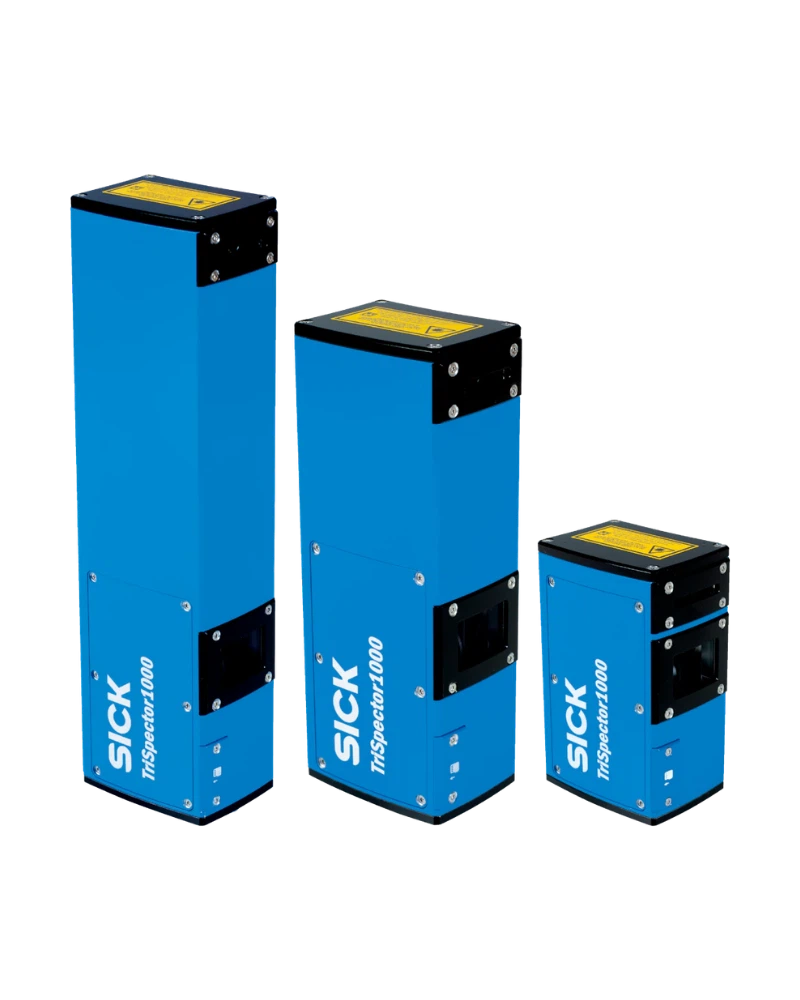
Explore performance details, construction highlights, applications, and technical information in one clear overview.
The TriSpector1000 is a machine vision solution designed for precise inspection tasks, including connection verification, fine adjustment, and optimization of image acquisition parameters. It supports full configuration setup and validation of image settings, task configurations, result settings, and interface settings. The system enables comprehensive testing of predefined functions through iterative refinement to ensure optimal performance in real-world conditions. As part of a complete service offering, the TriSpector1000 undergoes alignment, wiring inspection, and functional verification to meet application-specific requirements. This ensures reliable operation with accurate detection of good/failed test objects as defined by customer specifications. The solution is delivered with full documentation and training for end-users, ensuring smooth integration and long-term operational success.
The TriSpector1000 leverages advanced machine vision technology to perform inspection tasks such as connection checks and fine-tuned parameter optimization. It supports the setup of pre-defined functions including image settings, task configurations, result settings, and interface configurations. The system enables iterative testing and adjustment during operation to refine image acquisition and application-specific performance. A feasibility study is conducted prior to installation to assess environmental influences and mechanical constraints. This ensures that all technical characteristics—including object variants, ambient conditions, and mechanical setup—align with the defined specifications. The solution includes function and communication tests, as well as verification of sensor interface performance using customer-provided test objects.
The TriSpector1000 is engineered for reliable inspection performance under controlled conditions. It operates within a range of ambient environments that have been validated during the feasibility study phase. The product's technical characteristics, including object variants and mechanical setup, are fully aligned with specifications defined in the feasibility study. The unit weight and net unit weight are both 0 kilograms, indicating minimal physical footprint and no mass contribution. All components are designed for ease of access and maintenance without requiring tools. The system is configured from factory settings, ensuring a consistent baseline prior to application-specific adjustments.
The TriSpector1000 integrates seamlessly into existing industrial systems through standard electrical connections and host communication interfaces. Installation includes mounting, electrical connection, and integration with the plant infrastructure. The system is configured using factory default settings prior to application-specific tuning. Supply voltage and host interface connectivity are available at the installation site, enabling immediate setup. The product and programming interface are designed for easy access without tools, simplifying both initial configuration and ongoing maintenance. Configuration adjustments—such as image settings, task logic, result evaluation, and interface parameters—are performed iteratively to optimize performance based on real-world test data.
The TriSpector1000 operates within environments that have been validated during the feasibility study. Environmental conditions such as lighting, temperature, vibration, and ambient noise are assessed and confirmed to meet application requirements. The system is designed for operation in industrial settings where mechanical stability and consistent object positioning are maintained. The availability of the plant throughout the service duration ensures uninterrupted testing and optimization. Test objects—both good and failed cases—are provided by the customer and used to verify detection accuracy according to specified criteria. This ensures that the inspection process reliably distinguishes between acceptable and defective conditions under real-world operating conditions.
The TriSpector1000 is ideal for applications requiring precise visual inspection of connections, alignment, or component integrity. It supports tasks such as fine adjustment of mechanical components and optimization of image acquisition parameters to meet quality standards. The system is particularly suited for environments where consistent detection of good/failed states is required based on predefined specifications. Applications include automated inspection lines in manufacturing processes where connection verification or positional accuracy is critical. By combining pre-defined configurations with iterative testing, the TriSpector1000 ensures reliable and repeatable results across production cycles, supporting quality control and process optimization in industrial settings.
| Specification | Value |
|---|---|
| Supply voltage | and host connection are available at the installation site |
| interface | for the machine or plant with test objects provided by the customer |
| Unit weight | 0.000 Kilograms |
| Net unit weight | 0 Kilograms |
Browse product families and jump into the exact catalog section you need.