
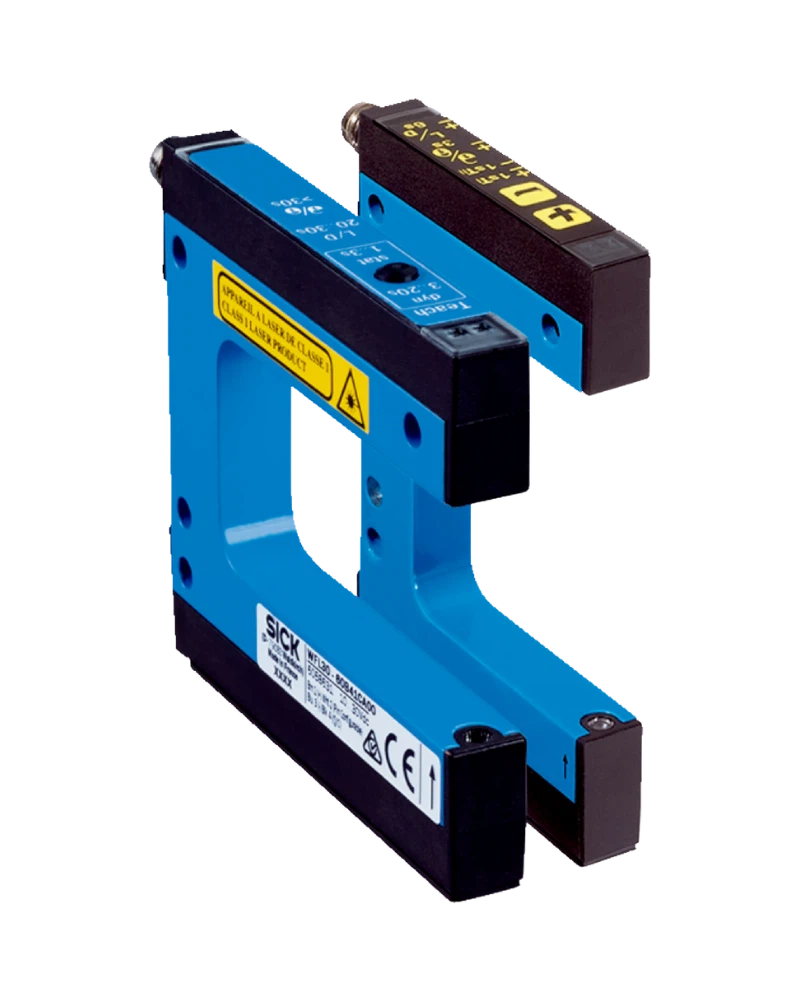
Explore performance details, construction highlights, applications, and technical information in one clear overview.
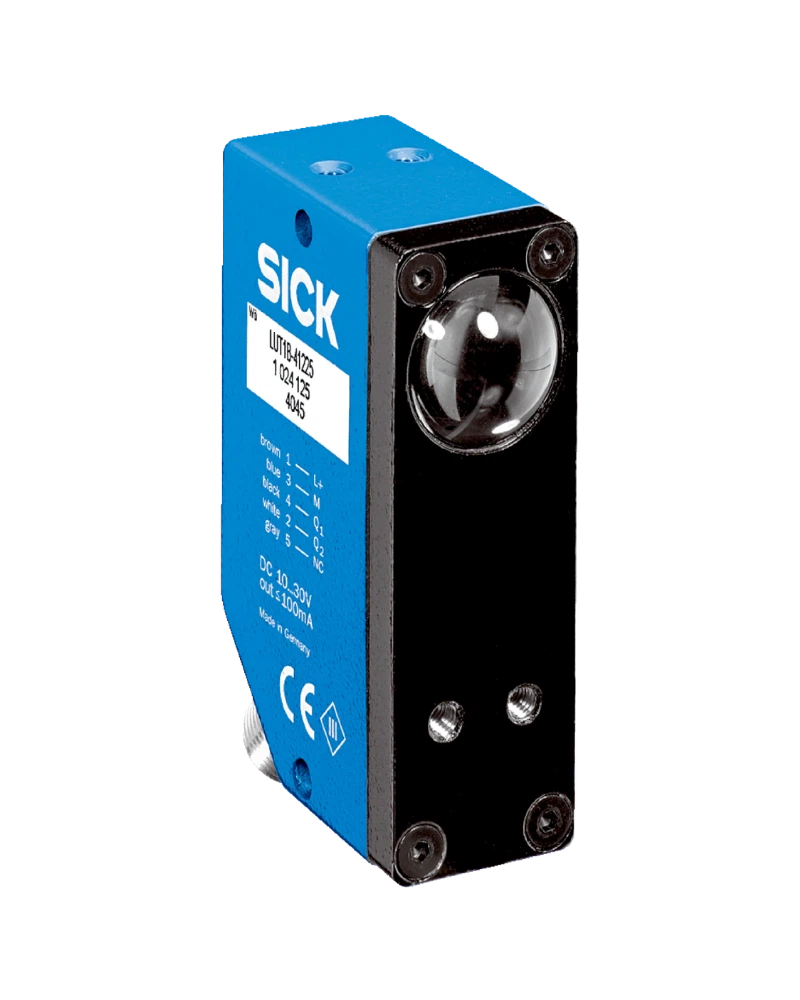
The SICK WFL fork sensor is a compact, reliable optical detection device designed for precise object presence sensing in industrial environments. Based on a laser-based optical principle, it detects objects by monitoring changes in light intensity when an object interrupts the beam. With a robust design and high sensitivity, this sensor ensures accurate detection of even very small objects down to 0.05 mm. The WFL series is ideal for applications requiring fast response times and stable performance under varying conditions. Its compact dimensions (10 mm x 158.5 mm x 74 mm) and lightweight construction (approx. 36 g to 160 g) make it suitable for integration into tight spaces or automated systems where space and reliability are critical.
The WFL fork sensor utilizes a visible red laser light source to detect objects through a light/dark switching mechanism. This principle ensures high sensitivity and fast response, with a minimum detectable object (MDO) of 0.05 mm. The sensor operates at a switching frequency of up to 10 kHz and features a response time of ≤ 100 µs, with stability within ±20 µs, ensuring consistent performance over time. The device is built with a durable aluminum housing and includes comprehensive circuit protection such as reverse polarity protection, UV connections, output short-circuit protection, and interference pulse suppression. Safety is prioritized through its protection class III certification, while the laser beam must never be directed at people’s eyes—do not intentionally look into the laser beam.
The WFL fork sensor operates within a supply voltage range of 10 V DC to 30 V DC, with ripple less than 10%. It consumes a current of 40 mA and delivers a maximum output current (I max) of 100 mA. The switching output is available in both PNP and NPN configurations: for PNP, HIGH = U V ≤ 2 V / LOW ≈ 0 V; for NPN, HIGH ≈ U V / LOW ≤ 2 V. The sensor features a response time of ≤ 100 µs with ±20 µs stability. It is designed to function reliably in ambient temperatures ranging from –20 °C to +50 °C and has a connection type of male M8, 4-pin. All specifications are based on official SICK documentation and reflect the device’s intended performance under standard operating conditions.
The WFL fork sensor is designed for straightforward integration into industrial control systems via its male M8, 4-pin connector. The PNP/NPN switching outputs allow compatibility with a wide range of PLCs and control devices. The output voltage levels are clearly defined: in PNP mode, the HIGH state is ≤2 V (with U V as supply), and LOW is approximately 0 V; in NPN mode, HIGH is approximately U V, and LOW is ≤2 V. The device includes reverse polarity protection and UV connection safeguards to prevent damage during installation or operation. Its compact footprint and stable switching behavior make it suitable for use in automated assembly lines, material handling systems, and other environments requiring reliable object detection without complex wiring or calibration.
The WFL fork sensor is designed to operate reliably within an ambient temperature range of –20 °C to +50 °C. This wide operating range ensures performance in both cold storage and high-temperature industrial settings. The device is constructed from aluminum, providing durability against mechanical stress and environmental exposure. It is suitable for use in standard industrial environments with typical levels of dust, vibration, and electromagnetic interference. However, it must not be exposed to direct sunlight or intense light sources that could interfere with the laser beam detection. Users are advised not to intentionally look into the laser beam, as this poses a safety risk.
The SICK WFL fork sensor is ideal for applications requiring precise and fast object detection in automated processes. It is commonly used in material handling systems, such as conveyor lines or robotic arms, where the presence of small components must be reliably detected. Its high sensitivity (MDO: 0.05 mm) makes it suitable for detecting thin or small parts during assembly or inspection tasks. The sensor’s fast response time (≤100 µs) and stable performance ensure real-time feedback in dynamic environments. Applications include packaging, automotive manufacturing, and quality control processes where reliable detection of objects is essential to maintain process integrity and efficiency.
| Specification | Value |
|---|---|
| Light source | Laser, visible red light |
| Supply voltage | 10 V DC ... 30 V DC |
| Current consumption | 40 mA 1) |
| Switching frequency | 10 kHz |
| Response time | ≤ 100 µs |
| Switching output | (voltage) |
| Protection class | III 2) |
| Housing material | Aluminum |
| Weight | Approx. 36 g ... 160 g 1) |
| Dimensions | (W x H x D) |
| Connection type | Male connector M8, 4-pin |
| Ambient temperature | , storage |
| Dimensions (W x H x D) | 10 mm x 158.5 mm x 74 mm |
| value | IP65 |
| Minimum detectable object (MDO) | 0.05 mm |
| Ripple | < 10 % |
| Stability of response time | ± 20 µs |
| Switching output (voltage) | PNP: HIGH = U V ≤ 2 V / LOW approx. 0 V NPN: HIGH = approx. U V / LOW ≤ 2 V |
| Output current I max. | 100 mA |
| Circuit protection | U V connections, reverse polarity protected Output Q short-circuit protected Interference pulse suppression |
| Connection type Male connector M8, 4-pin | Connection type | Male connector M8, 4-pin |
| Ambient operating temperature | –20 °C ... +50 °C |
| Ambient temperature, storage | –30 °C ... +80 °C |
| Ambient light immunity | ≤ 10,000 lx |
| Enclosure rating | IP65 |
| Unit weight | 0.114 Kilograms |
| Net unit weight | 0.114 Kilograms |
| PNP | HIGH = U V ≤ 2 V / LOW approx. 0 V |
| NPN | HIGH = approx. U V / LOW ≤ 2 V |

Browse product families and jump into the exact catalog section you need.