
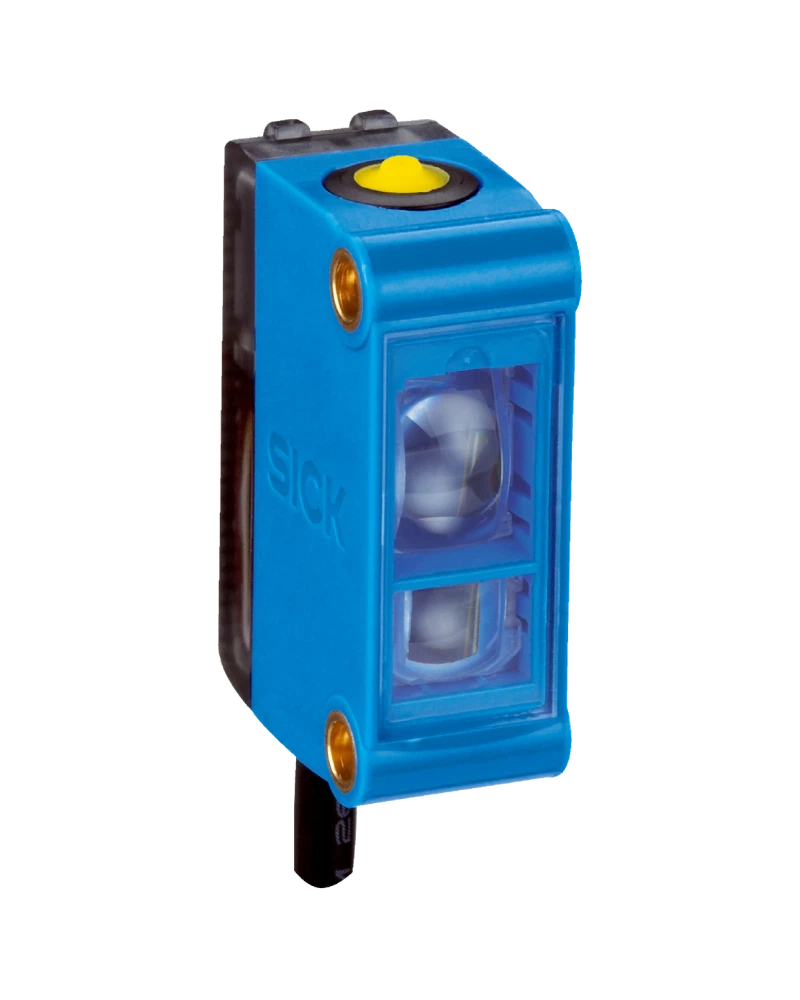
Explore performance details, construction highlights, applications, and technical information in one clear overview.
The SICK LUTM luminescence sensor is a compact, reliable solution for detecting fluorescent marks that emit visible light when exposed to ultraviolet (UV) radiation. Designed specifically for applications where only fluorescent substances are present, the LUTM detects these materials by sensing the reflected visible light generated during UV excitation. With its miniature housing and IO-Link functionality, the sensor offers seamless integration into existing automation systems while maintaining high detection accuracy. The LUTM is ideal for environments requiring precise identification of fluorescent markings on surfaces such as packaging, labels, or components. Its compact dimensions (12 mm x 31.5 mm x 21 mm) and robust construction ensure it fits efficiently in tight spaces without compromising performance.
The LUTM utilizes advanced luminescence detection technology to identify fluorescent materials that only become visible under UV light. Fluorescent substances absorb UV radiation and re-emit it as visible light, which the sensor detects through a built-in light source emitting in the UV range. This ensures reliable detection of marks that do not reflect ambient light, reducing false triggers from non-fluorescent surfaces. The sensor’s technology is based on a proven principle: only fluorescent materials generate detectable reflected light under UV exposure. With its small footprint and IO-Link interface, the LUTM enables real-time data exchange with control systems for enhanced process monitoring and diagnostics.
The LUTM luminescence sensor features a housing made of ABS material, offering durability and resistance to environmental stress. It operates with a supply voltage range of DC 12 V to 24 V and delivers a switching output with a maximum frequency of 6 kHz. The response time is as fast as 80 µs, enabling quick detection cycles in dynamic processes. The sensor provides light/dark switching functionality and features a PNP switching output where high = VS– ≤ 2 V and low ≈ 0 V. It has a current output capability (Imax) suitable for standard industrial logic circuits. The sensor is protected to Class III, with an IP 67 enclosure rating ensuring full protection against dust and immersion in water up to 1 meter for 30 minutes.
The LUTM is configured with a cable featuring a male M12 connector and a 4-pin connection, allowing straightforward integration into existing systems. The sensor includes matching holders that ensure compatibility with predecessor models, simplifying retrofitting and reducing installation time. Its IO-Link function enables direct communication with host controllers, providing real-time status updates, diagnostics, and configuration adjustments without the need for additional hardware. This feature supports intelligent process control by allowing parameter monitoring and fault detection directly from the sensor. The compact design and standardized interface make it easy to install in automated lines or inspection stations where space is limited.
The LUTM operates reliably within an ambient temperature range of –10 °C to +55 °C, making it suitable for a wide variety of industrial environments. The sensor’s IP 67 rating ensures complete dust protection and resistance to immersion in water up to 1 meter deep for 30 minutes, ideal for use in wet or dirty conditions such as manufacturing floors or outdoor installations. It is designed for stable performance under varying environmental conditions without degradation in sensitivity or response time. The housing material (ABS) contributes to mechanical robustness while maintaining thermal stability across operating temperatures.
The LUTM luminescence sensor is ideal for applications requiring the detection of fluorescent marks on packaging, labels, or product components. It is particularly effective in quality control processes where only specific markings need to be verified under UV light. Common use cases include detecting anti-counterfeiting features, verifying label presence, or identifying product serial numbers that are invisible under normal lighting. The sensor’s small size and reliable detection make it suitable for integration into automated inspection lines, packaging machines, and assembly stations where space and accuracy are critical.
| Specification | Value |
|---|---|
| dimensions | (L x W x H) 12 mm x 31.5 mm x 21 mm |
| light source | 1) 2) uV -L ed |
| supply voltage | Vs 1) DC 12 V ... 24 V |
| switching frequency | for |
| response time | 5) 80 µs |
| weight | Approx. 70 g |
| housing material | aBS |
| Switching output | pnp |
| connector | M12, |
| Ambient temperature | Operation |
| wavelength | in the visible |
| interface | facilitates remote control and rapid |
| Dimensions | in mm (inch)) |
| switching output | Q |
| housing | and IO-Link function. A cable with M12 male connector |
| value | bar, L-shaped, 250 |
| output | function 3) Light/dark switching |
| Switching output pnp | high = VS– ≤ 2 V / LOW approx. 0 V |
| connection | type Male connector M12, 4-pin |
| Ambient temperature Operation | –10 °C ... +55 °C |
| range | 1) |
| sensing distance | in mm (inch) |
| mounting | bar, L-shaped, 250 |
| Vs 1) DC | 12 V ... 24 V |
| high | VS– ≤ 2 V / LOW approx. 0 V |
| Approx. | 70 g |
| length of | 375 nm. Fluorescent substances are excited by |
| Switching frequency of | 6 kHz |
| Dimensions (L x W x H) | 12 mm x 31.5 mm x 21 mm |
| Supply voltage Vs 1) DC | 12 V ... 24 V |



Browse product families and jump into the exact catalog section you need.