
Explore performance details, construction highlights, applications, and technical information in one clear overview.
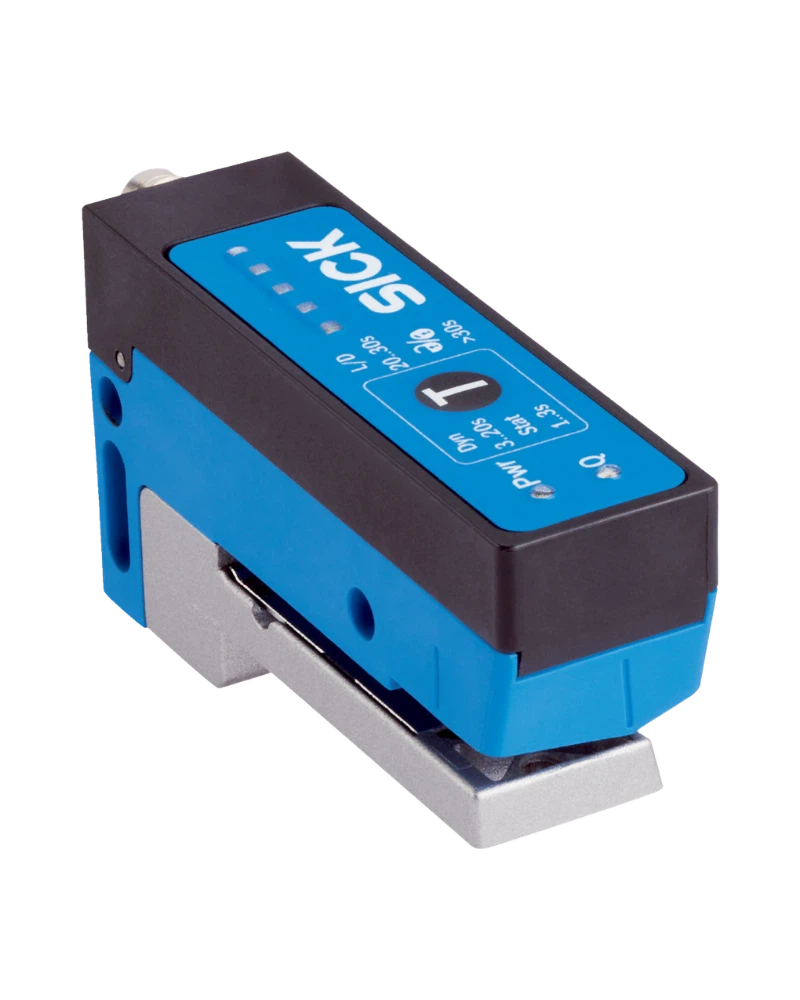
The SICK UFS fork sensor is a compact, ultrasonic solution designed for reliable label detection on carrier materials in high-speed packaging processes. With its slim profile and direct installation at the dispensing edge, the UFS minimizes web flutter and improves process accuracy. Unlike traditional optical sensors, it reliably detects labels regardless of color, pattern, transparency, gloss level, or reflectivity. The sensor distinguishes labels from the carrier material by measuring signal attenuation—labels dampen the ultrasonic signal more than the base material alone. This makes it ideal for applications where optical detection fails, such as with transparent, reflective, or deep black labels. As the first ultrasonic fork sensor with a lower flank height of only 5.5 mm, the UFS offers superior space efficiency without compromising performance.
The UFS leverages powerful ultrasonic technology to detect a wide range of label materials, including transparent, reflective, and deep black labels—conditions that often challenge optical sensors. It operates by measuring signal attenuation: when a label is present on the carrier material, it dampens the ultrasonic wave more than the material alone, allowing accurate detection. This principle enables reliable identification even in complex labeling scenarios with diverse optical properties such as patterns, colors, and markings. The sensor's robust technology ensures stable performance under varying ambient lighting conditions and eliminates issues caused by gloss or light interference. Its ability to detect label gaps as small as 1 mm at speeds up to 2.2 m/s contributes to high material efficiency and process consistency.
The UFS features a lower flank height of only 5.5 mm, making it the first ultrasonic fork sensor in its class with such a slim profile. This compact design enables space-saving installation directly at the dispensing edge, reducing web flutter and enhancing process accuracy. The sensor is compatible with existing mounting systems used for the UFN and WFS variants, ensuring seamless integration into current machine designs. Detection is based on signal attenuation differences between carrier material and labeled material, allowing reliable identification of labels across a broad spectrum of materials. It operates effectively at speeds up to 2.2 m/s and can detect label gaps as small as 1 mm without error.
The UFS includes an integrated IO-Link communication interface that enables quick configuration during operation, eliminating the need for local sensor access. This allows for real-time fine-tuning, automatic reporting of events such as web tears, and in-process teaching-in and sensor configuration. The compact housing design supports easy changeover from optical detection to ultrasonic technology without requiring fixture modifications—making it a flexible upgrade option. With no need for retooling or structural changes, the UFS simplifies retrofitting and enhances machine adaptability across different labeling applications.
The UFS is designed to operate reliably in industrial environments with stable performance under varying ambient conditions. It is unaffected by gloss levels, light intensity, or ambient illumination—ensuring consistent detection regardless of surface characteristics. The sensor performs equally well on transparent, reflective, and deep black labels, overcoming limitations common in optical systems. Its robust ultrasonic technology ensures stability across different environmental settings without degradation in performance, making it suitable for continuous operation in demanding packaging lines where material variability is high.
The UFS is ideal for use in high-speed packaging and labeling applications where label detection must be accurate despite challenging material properties. It is particularly effective in environments with transparent, reflective, or patterned labels that are difficult to detect using optical sensors. Common applications include carton, film, and pouch labeling processes where process speed exceeds 2.2 m/s. Its ability to detect small gaps (as low as 1 mm) ensures high material efficiency and reduces waste. The sensor’s compact size and ease of integration make it suitable for retrofitting existing machines or incorporating into new designs requiring reliable, space-efficient label detection solutions.
| Specification | Value |
|---|---|
| interface | also opens up numerous possibilities such as fine adjustment, analyses and monitoring, e.g., for automatic reporting of a web tear, as well as teach-in and sensor configuration during the running process. |
| accuracy | due to minimization of web flutter. The UFS is the first ultrasonic fork sensor with a lower flank height of only 5.5 mm. In spite of its compact design, the sensor is compatible with the mounting systems of the UFN and WFS variants. |
| material | based on their signal attenuation: labels on carrier material dampen the signal more than the carrier material alone. This means that even labels that cannot be detected by optical solutions are identified. |
| Compact size | with a lower flank height of only 5.5 mm, the UFS is significantly slimmer than comparable ultrasonic fork sensors. |
| High material efficiency | even very small label gaps from 1 mm can be detected by the UFS without error at up to 2.2 m/s. |
| Receive immediate feedback from the bar graph on the sensor display | Assess the quality of the teach-in instantly and determine whether the sensor is adjusted correctly or needs to be readjusted. During operation, the display indicates the stability of the detection performance (Quality of Run) at a glance. |

Browse product families and jump into the exact catalog section you need.