
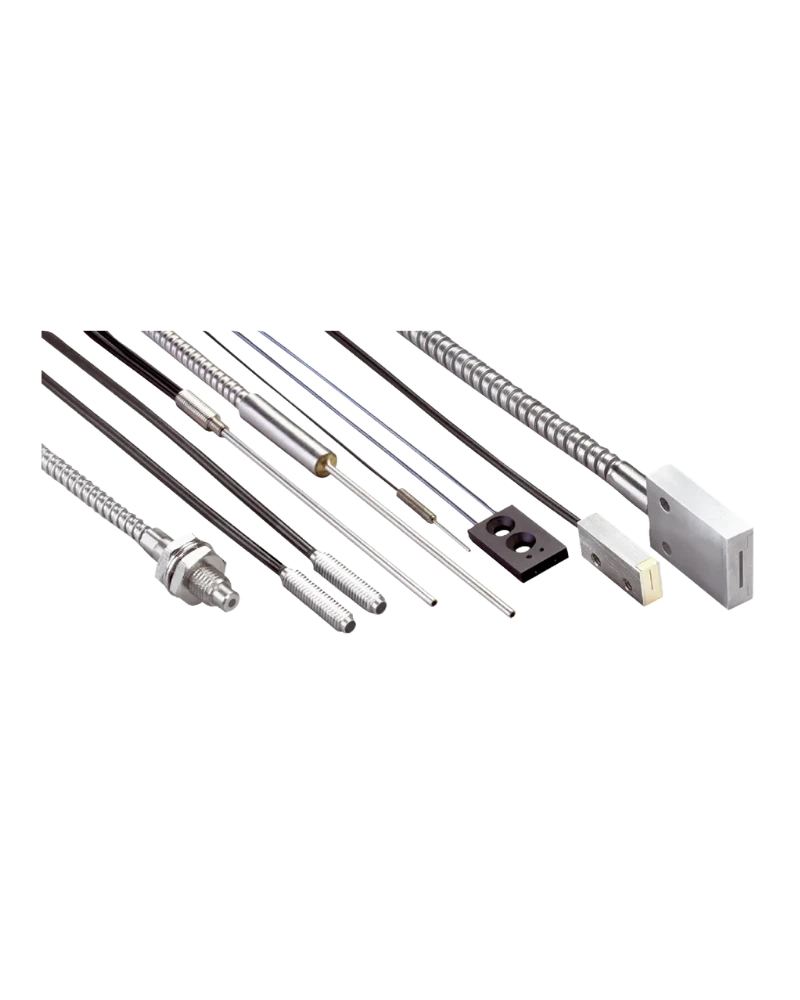
Explore performance details, construction highlights, applications, and technical information in one clear overview.
The SICK LL3 fiber-optic sensor is a proximity detection device based on optical principles, designed for precise and reliable object detection in industrial environments. Utilizing a coaxial fiber-optic cable with an integrated lens, the LL3 detects objects through axial light emission and reflection, offering high sensitivity down to a minimum detectable object diameter of 0.015 mm under optimal conditions. The sensor operates across multiple measuring ranges depending on the selected operating mode, enabling flexible adaptation to various application requirements. With a robust construction featuring stainless steel housing and PE sheath, it delivers durability in demanding settings. Its compact design, weighing only 39 g, makes it ideal for integration into tight or space-constrained systems where reliable proximity sensing is essential.
The LL3 employs a proximity system using fiber-optic technology with axial light emission to detect objects. The sensor features an integrated lens with a 60° angle of dispersion, ensuring broad detection coverage without requiring external lenses or tip adapters. It is designed for use in environments where electromagnetic interference must be avoided, as it operates independently of electrical signals. The optical fiber head is constructed from stainless steel and contains PMMA fibers, providing excellent signal transmission and stability. No compatibility with infrared light is supported, and the sensor cannot be fitted with external tip adapters. However, the optical fiber cable can be shortened to suit specific installation needs, offering flexibility in system design while maintaining performance integrity.
The SICK LL3 has a maximum sensing range that varies by operating mode: 90 mm at 16 µs, 280 mm at 70 µs, 500 mm at 250 µs, and up to 900 mm at 2 ms. The optical fiber taper diameter is ≥2.8 mm, ensuring mechanical stability and signal quality. The outside diameter of the cable connection is 2.2 mm, contributing to minimal profile impact during installation. Threaded housing features a standard M6 thread for secure mounting. The sensor operates within an ambient temperature range of –40 °C to +70 °C, making it suitable for extreme environmental conditions. Weight is 39 g, and the fiber-optic head does not support compatibility with infrared light or external tip adapters.
The LL3 is designed for straightforward integration into industrial systems due to its standard M6 thread housing and compact form factor. The sensor can be mounted directly onto machinery or enclosures using standard threaded fasteners. While the optical fiber cable can be shortened, adapter end sleeves are not required, simplifying installation. No external tip adapters are compatible with this model, ensuring a direct connection between the sensor head and the optical fiber. The axial light emission principle ensures minimal interference from electrical noise, making it ideal for use in high-noise or EMI-prone environments. Integration is supported without additional signal processing hardware, as the sensor provides a simple proximity output based on detected object presence.
The SICK LL3 is engineered to operate reliably across a wide ambient temperature range of –40 °C to +70 °C. This makes it suitable for use in both cold storage facilities and high-temperature industrial processes. The sensor’s construction, featuring stainless steel housing and PE sheath with PMMA fibers, ensures resistance to mechanical stress and environmental degradation. It is not designed for use with infrared light, and its performance remains stable under normal operating conditions. The device does not require special environmental certifications beyond standard industrial requirements. Operation is unaffected by typical dust or moisture levels when used within specified ambient conditions.
The LL3 fiber-optic sensor is ideal for applications requiring precise, non-contact object detection in harsh environments. It is commonly used in packaging, material handling, and assembly lines where reliable proximity sensing is critical. The ability to detect objects as small as 0.015 mm makes it suitable for monitoring thin materials or detecting micro-features during production. Its wide range of operating modes allows adaptation to different detection distances, supporting diverse process requirements. Applications include edge detection, presence/absence sensing, and position verification in automated systems. The sensor’s immunity to electromagnetic interference ensures consistent performance even in electrically noisy environments.
| Specification | Value |
|---|---|
| Weight | 39 g |
| Sensing range | max. |
| Material | Optical fiber head Stainless steel Sheath Polyethylen (PE) Fibers Polymethylmethacrylat (PMMA) |
| Minimal object diameter | 0.015 mm 1) |
| value | 170 mm |
| Thread diameter (housing) | M6 |
| Optical fiber taper diameter | ≥ 2.8 mm |
| Outside diameter, optical fiber cable connection | 2.2 mm |
| Ambient operating temperature | –40 °C ... +70 °C |
| Operating mode 16 µs | 90 mm |
| key | Operating mode 250 µs |
| Operating mode 70 µs | 280 mm |
| Operating mode 250 µs | 170 mm |
| Operating mode 2 ms | 900 mm |
| Operating mode 8 ms | 1,350 mm |
| Operating mode 50 µs | 90 mm |
| Unit weight | 39.000 Grams |
| Net unit weight | 39 Grams |
| Optical fiber head Angle of dispersion | 60° Integrated lens No Compatibility tip adapters No |
| Operating mode | 250 µs |
| https | //www.sick.com/gb/en/catalog/products/detection-sensors/fiber-optic-sensors-and-fibers/ll3/ll3-db01-3/p/p261661 |
Browse product families and jump into the exact catalog section you need.