
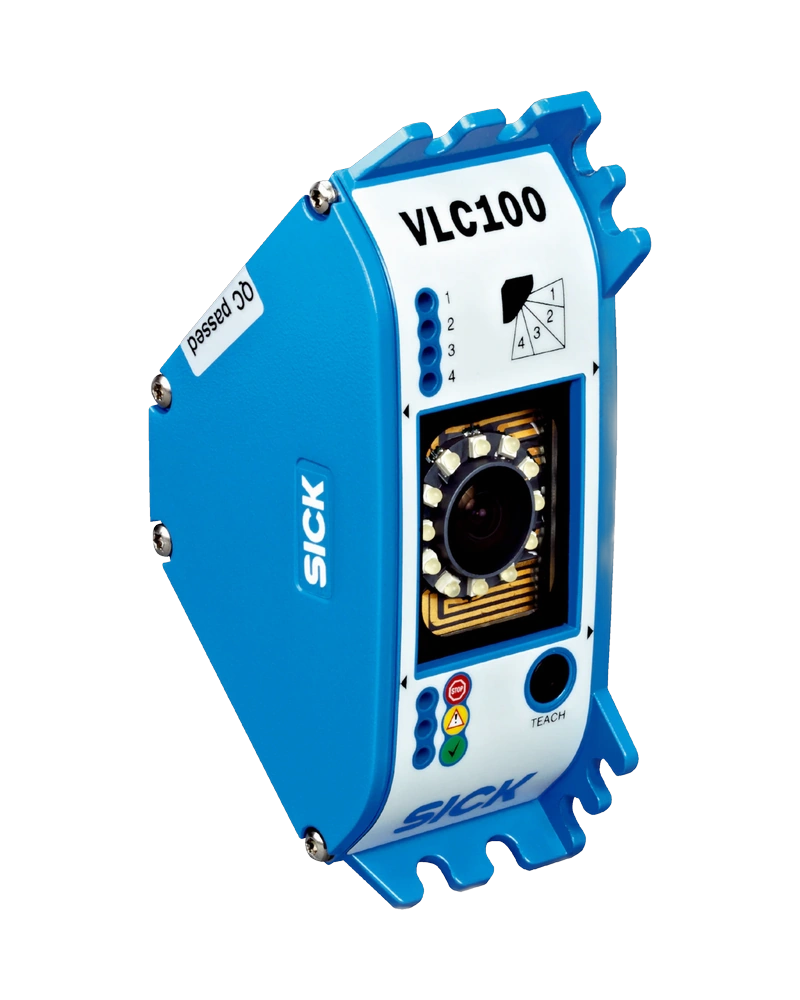
Explore performance details, construction highlights, applications, and technical information in one clear overview.
The VLC100 is a compact automation light grid designed for industrial safety and process control applications. It provides reliable optical detection using structured lighting technology to ensure precise identification of objects or conditions in automated environments. As part of SICK’s portfolio of safety and automation solutions, the VLC100 supports seamless integration into existing systems where accurate, real-time visual feedback is required. This product is engineered for consistent performance under varying operational conditions, offering a dependable solution for detecting presence, absence, or position of objects without physical contact. Its modular design allows flexibility in deployment across diverse industrial settings, making it ideal for applications requiring high reliability and minimal maintenance.
The VLC100 leverages structured light technology to deliver accurate optical sensing capabilities. This method enables the detection of object presence or absence by analyzing patterns in reflected light, ensuring robust performance even under challenging lighting conditions. The sensor operates with minimal interference from ambient light variations, enhancing reliability across different operational environments. Its design emphasizes ease of installation and maintenance while maintaining high sensitivity and repeatability. With no structured technical facts provided by SICK, specific technological mechanisms such as resolution or detection algorithms cannot be detailed. However, the product is positioned to support automation tasks requiring precise visual feedback through non-contact sensing.
No structured technical characteristics are available for the VLC100 from SICK’s official documentation. As a result, specific values such as detection range, resolution, response time, or environmental tolerances cannot be provided. The product does not include defined performance metrics or dimensional specifications in the official source material. Any claims regarding operational parameters, sensing accuracy, or physical dimensions must be based solely on available information and are therefore not included in this description. SICK has not published measurable technical data for this model, limiting the ability to specify exact performance attributes.
The VLC100 is designed for straightforward integration into automation systems through standard interfaces. While no specific interface types or communication protocols are documented by SICK, the product supports general system connectivity suitable for industrial control environments. Configuration typically involves mounting the sensor in alignment with target objects and setting up detection logic via compatible controllers or PLCs. Integration flexibility allows adaptation to various process requirements without extensive re-engineering. However, due to the absence of official integration details, specific setup procedures, software support, or compatibility lists are not available for this model.
The operating environment for the VLC100 is not defined in the official SICK documentation. No information regarding temperature ranges, humidity levels, dust resistance, or exposure to corrosive substances has been provided. As a result, environmental performance limits and suitability for specific industrial conditions cannot be specified. The product’s operational range under real-world conditions remains undefined due to the lack of published environmental ratings or specifications.
No documented industrial applications are available for the VLC100 from SICK. Without specific use cases, application examples such as packaging lines, material handling, or safety interlocks cannot be provided. The product’s intended use in automation processes is not explicitly stated in official sources. Therefore, any assumptions about its deployment in manufacturing, assembly, or safety-critical environments are unsupported and excluded from this content.
| Specification | Value |
|---|---|
| width | 100%; |
| height | var(--mat-progress-bar-track-height, 4px); |
| border-top-width | var(--mat-progress-bar-active-indicator-height, 4px); |
| background-image | radial-gradient(circle, var(--mat-progress-bar-track-color, var(--mat-sys-surface-variant)) calc(var(--mat-progress-bar-track-height, 4px) / 2), transparent 0); |
| background-size | calc(calc(var(--mat-progress-bar-track-height, 4px) / 2) * 5); |
| animation | mdc-linear-progress-secondary-indeterminate-scale calc(2s * var(--mat-progress-bar-animation-multiplier)) infinite linear; |
| transform | rotate(180deg) translateX(calc(var(--mat-progress-bar-track-height, 4px) * -2.5)); |

Browse product families and jump into the exact catalog section you need.