
Explore performance details, construction highlights, applications, and technical information in one clear overview.
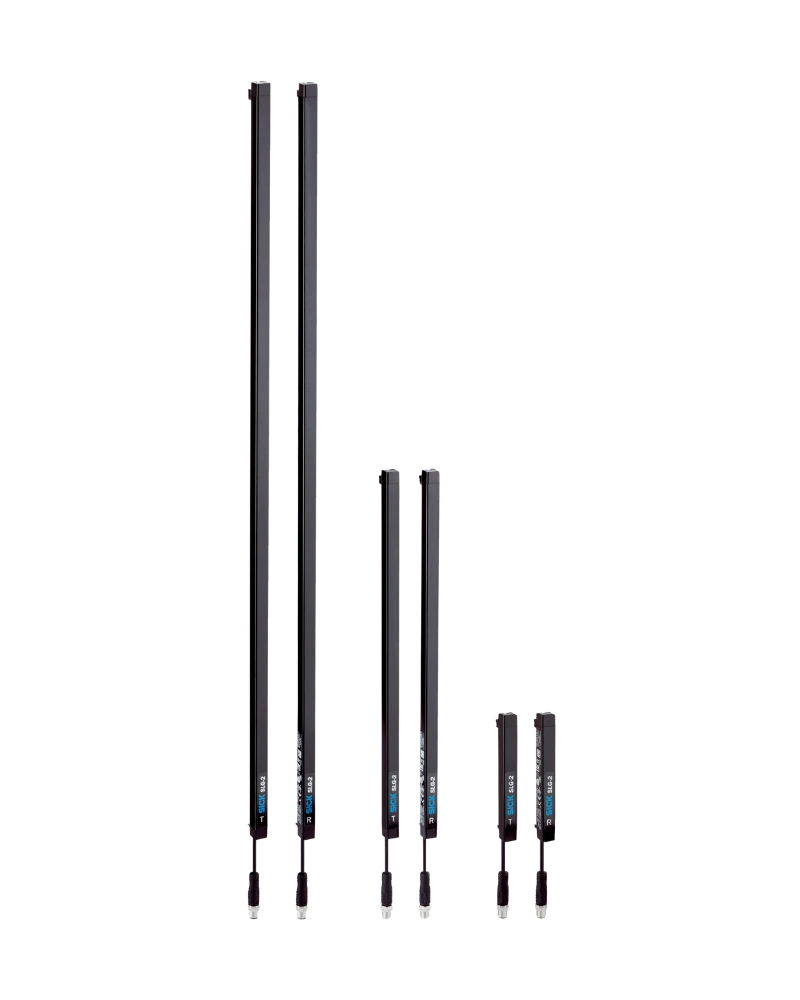
The SICK SLG-2 is an automation light grid sensor designed for reliable object detection in industrial environments. Utilizing a sender-receiver functional principle, it employs 48 infrared LED beams to detect objects with high precision and minimal false triggers. The sensor offers both parallel beam and three cross-beam configurations, providing flexibility depending on application requirements. With a detection height of up to 1,200 mm, the SLG-2 ensures consistent performance across a wide range of industrial setups. Its compact design features a small footprint with precise beam positioning—4.6 mm from the first beam to the housing connection side and 19.6 mm from the last beam to the top—making it ideal for integration into tight spaces. The sensor is built for durability, offering protection against environmental factors when used in external housings.
The SLG-2 leverages infrared LED technology with 48 beams arranged in a parallel beam configuration (recommended), delivering fast scan times of just 2.5 ms. This high-speed detection enables real-time monitoring for dynamic processes. The sensor supports three cross beams, which enhance detection capability and improve sensitivity to smaller objects—minimum detectable object (MDO) of ≥16.5 mm in this configuration. Infrared light ensures reliable operation without interference from visible light sources. All beam functions are protected against overcurrent and short circuits, while UV connections provide reverse polarity protection for safe installation. The sensor’s detection capability is optimized based on sensing range, number of beams, and cross-beam arrangement—ensuring consistent performance across different operational conditions.
The SLG-2 features a parallel beam configuration with a recommended range from 440 mm to 3,500 mm. Beam separation is precisely set at 25 mm, contributing to accurate object detection. The minimum detectable object (MDO) for the parallel beam is 30 mm, while for the three cross beams it is ≥16.5 mm. Scan time for the parallel beam is 2.5 ms and for cross beams is 4.9 ms. The sensor emits infrared light using LED technology across 48 beams. Detection height is rated at 1,200 mm. For detection heights below 700 mm, measured values may vary by up to 1 mm due to environmental or positioning factors. All technical specifications are based on standard operating conditions and depend on sensing range, beam count, and cross-beam configuration.
The SLG-2 supports IO-Link communication for full process data exchange, enabling remote configuration of sensor parameters and Smart Task functions. Through IO-Link, users can monitor system status, beam status, and quality status in real time. This allows for seamless integration into automation systems with minimal setup effort. The sensor is designed to be easily configured via the IO-Link interface without requiring manual adjustments. Reverse polarity protection on UV connections ensures safe installation even under accidental wiring errors. Outputs are overcurrent and short-circuit protected, enhancing system reliability during operation.
The SLG-2 is designed for industrial use in a wide range of environments. It can operate outdoors only when installed within an external protection housing to ensure environmental protection. The sensor is rated for outdoor conditions under such housing, protecting it from moisture, dust, and extreme temperatures. For indoor applications, standard mounting is sufficient. The device operates reliably across typical industrial temperature ranges, with no specific limits stated in the documentation. However, detection performance may vary slightly at detection heights below 700 mm due to measurement tolerances of up to 1 mm.
The SICK SLG-2 is ideal for applications requiring reliable object presence detection in production lines and automated systems. It can be used in packaging, assembly, and material handling processes where consistent detection of objects on conveyors or at workstations is essential. The sensor’s high sensitivity—especially with the three cross-beam configuration—makes it suitable for detecting small or irregularly shaped objects with a minimum detectable size of ≥16.5 mm. Its fast scan time (2.5 ms) supports real-time control in high-speed operations. Applications include level detection, presence sensing, and object counting where precise and repeatable performance is required.
| Specification | Value |
|---|---|
| Detection height | 1,200 mm |
| Beam separation | 25 mm |
| Light source | LED |
| Number of beams | 48 |
| Protection class | III 3) |
| Connection type | Detail | Cable diameter | 3.4 mm | Conductor cross section | 0.14 mm² | Length of cable | 150 mm | Cable material | PVC |
| Weight | 1,760 g |
| Repeatability | , cross beam |
| response time | , cross beam |
| Supply voltage | U B |
| Dimensions | (W x H x D) | Width | 11.8 mm | Height | 1,199.2 mm | Depth | 24.1 mm |
| Material | Housing Aluminum Plastic Front screen PMMA |
| Ambient temperature | , storage |
| Switching output | , external input |
| detection height | < 700 mm, the measured value can vary by up to 1 mm from the measured values specified here. |
| sensing range | / number of beams / cross beam. |
| Parallel beam (recommended) | 440 mm ... 3,500 mm |
| value | IP65 1) IP67 |
| 3 x cross beam (recommended) | 440 mm ... 3,500 mm |
| Distance from 1st Beam to leading edge of housing (connection side) | 4.6 mm |
| Distance from last beam to leading edge of housing (top) | 19.6 mm 1) |
| key | Connection type Detail Cable diameter 3.4 mm Conductor cross section 0.14 mm² Length of cable 150 mm Cable material PVC |
| Minimum detectable object (MDO), parallel beam | 30 mm 2) |
| Minimum detectable object (MDO), 3 x cross beam | ≥ 16.5 mm 2) |
| Emitted beam Light source LED Type of light Infrared light Number of beams 48 | Emitted beam | Light source | LED | Type of light | Infrared light | Number of beams | 48 |
| Scan time, parallel beam | 2.5 ms |
| Scan time, cross beam | 4.9 ms |
| Repeatability, parallel beam | 2.5 ms |
| Repeatability, cross beam | 7.4 ms |
| Minimum dwell time, parallel beam | 4.9 ms |

Browse product families and jump into the exact catalog section you need.