
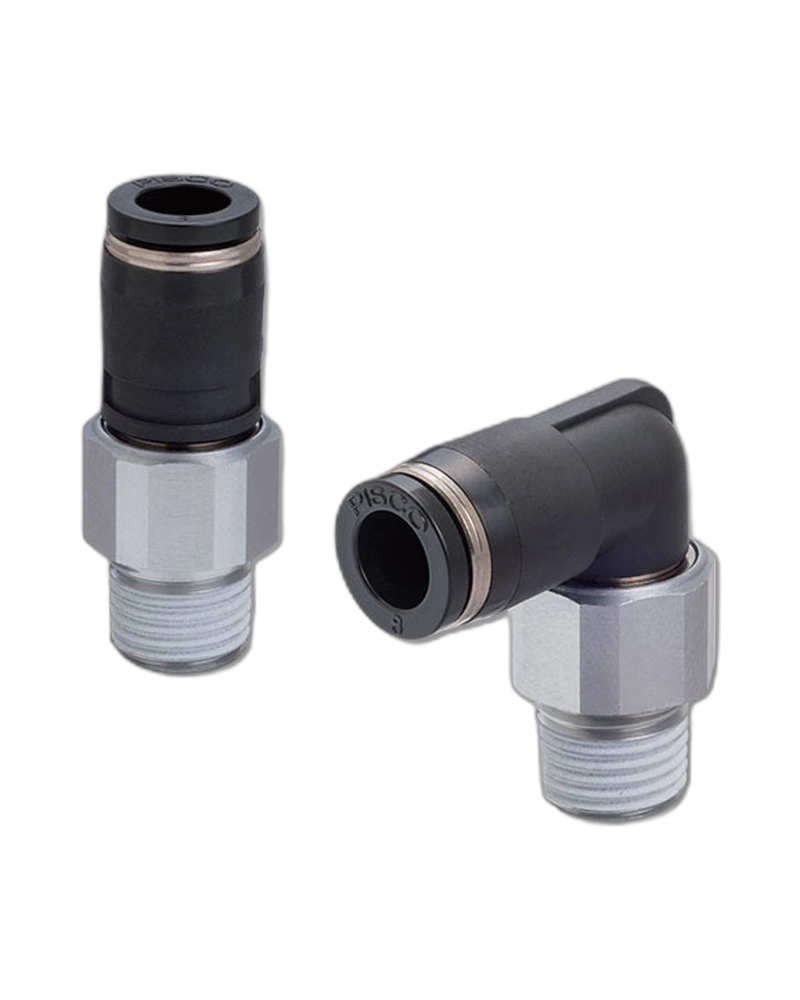
Explore performance details, construction highlights, applications, and technical information in one clear overview.
The Rotary Joint is a swiveling connection designed to allow smooth rotation and swinging motion between two parts in machinery such as robots or automated systems. It enables continuous movement without binding or mechanical stress, making it ideal for applications where rotating or pivoting components must maintain fluid or pneumatic connectivity while moving freely.
The joint features PBT resin for its primary structural components, a standard material well-suited for general environmental conditions. The main metal parts are constructed from brass with electroless nickel plating, providing durability and corrosion resistance in typical industrial settings. Seal rubber is provided in two materials: NBR for general sealing applications and FKM for superior performance under heat, chemical exposure, and ozone resistance.
The rotary joint uses a push-in fitting design with an integrated bearing system that supports low rotational torque. This configuration allows for easy assembly and disassembly while reducing mechanical load on moving parts such as robot arms or rotating shafts. The connection interface is compatible with multiple standard threading types including metric male threads (M5x0.8, M6x1), taper pipe male threads (R1/8, R1/4, R3/8, R1/2), and UNF and NPT threads (10-32UNF, NPT1/8, NPT1/4, NPT3/8, NPT1/2).
The rotary joint is rated for operation with air as the fluid medium. It can withstand a maximum operating pressure of 1.0MPa and a maximum vacuum of -100kPa. The operating temperature range is from 0°C to 60°C, ensuring reliable performance in non-freezing environments.
Available in multiple sizes, the rotary joint offers metric diameters of φ4, φ6, φ8, φ10, and φ12 mm, corresponding to inch sizes of φ5/32", φ3/16", φ1/4", φ5/16", φ3/8", and φ1/2". These size options provide flexibility for integration into a wide range of mechanical systems with varying bore requirements.
The push-in fitting design allows direct installation without the need for additional tools or complex alignment. The built-in bearing reduces load on swinging and rotating components, making it suitable for integration directly into robotic joints, swivel arms, or other moving assemblies where low torque and reliable motion are essential.
| Specification | Details |
|---|---|
| Fluid medium | Air |
| Max. operating pressure | 1.0MPa |
| Max. vacuum | -100kPa |
| Operating temp. range | 0
Recommended products
Related Products
CategoryBrowse product families and jump into the exact catalog section you need. |