
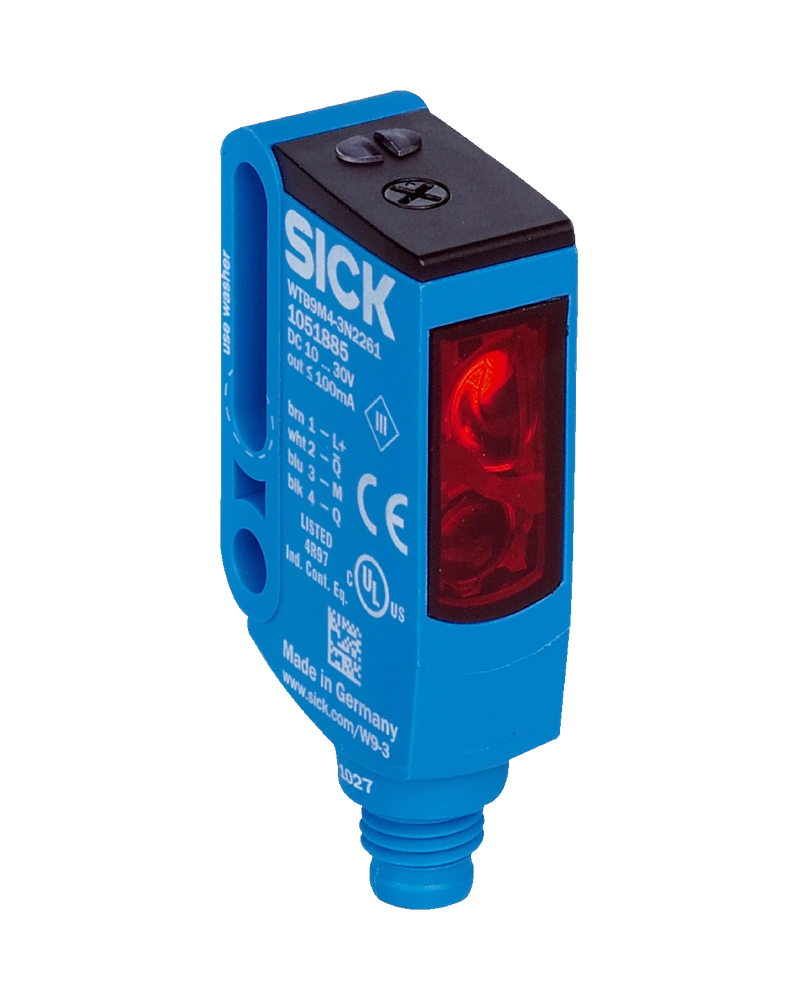
Explore performance details, construction highlights, applications, and technical information in one clear overview.
The SICK W9 is a compact retro-reflective photoelectric sensor designed for reliable detection in industrial environments. It operates using coaxial optics with autocollimation, enabling accurate object detection without requiring a separate reflector. This design ensures consistent performance and reduces installation complexity. The sensor emits visible red light via a PinPoint LED, providing clear signal transmission over distances up to 3 meters under normal conditions. With a maximum sensing range of 5 meters in short-circuit protected networks, the W9 delivers robust detection capabilities across various applications. Its small rectangular housing (12.2 mm × 50 mm × 23.6 mm) and M3 mounting hole make it ideal for tight spaces and integration into existing machinery. The PNP complementary output ensures compatibility with a wide range of control systems, while its fast response time supports high-speed automation tasks.
The W9 leverages a photoelectric retro-reflective principle with coaxial optics to detect objects without the need for an external reflector. This autocollimation technology ensures precise alignment and consistent performance even under varying environmental conditions. The sensor uses a PinPoint LED light source, which emits visible red light with a spot size of Ø 45 mm at 1.5 meters, ensuring focused detection. Its light/dark switching function enables reliable object presence detection by sensing changes in light intensity. With a response time of less than 0.5 ms and a switching frequency up to 1,000 Hz, the W9 is suitable for dynamic environments requiring rapid signal processing. The sensor's design includes reverse-polarity protection on both input (B) and output (A) connections, enhancing safety during installation and operation.
The SICK W9 operates within a supply voltage range of 10 V DC to 30 V DC, with ripple less than 5 V peak-to-peak. It consumes a steady current of 30 mA under normal operating conditions and delivers a maximum output current of ≤ 100 mA (reduced to 50 mA at or above Tu = 50 °C). The switching output is PNP complementary, enabling compatibility with standard industrial control systems. The sensing range is rated from 0 m to 3 m under normal operation, with a maximum range of 5 m when operated in short-circuit protected networks. The sensor features a 4-wire cable connection (up to 5 meters) and is designed for use in environments where signal integrity and reliability are critical. All electrical parameters adhere to specified tolerances, including voltage limits that must not be exceeded or fallen below.
The W9 integrates seamlessly into industrial automation systems via a 4-wire cable connection with a maximum cable length of 5 meters. The M3 mounting hole allows for secure installation on panels, frames, or other surfaces. The PNP complementary output ensures compatibility with most PLCs and control systems. Reverse-polarity protection is provided on both the A (output) and B (input) connections, reducing risk during wiring errors. The sensor's fast switching speed and high frequency capability support real-time monitoring applications. Installation requires only basic tools and standard mounting hardware. No external reflector is needed due to its coaxial optical design, simplifying setup and maintenance.
The W9 is designed for operation in industrial environments with ambient temperatures ranging from -10 °C to +60 °C. It is rated for use at a maximum operating temperature (Tu) of 50 °C, where the maximum load current is limited to 50 mA to ensure long-term reliability. The sensor's average service life exceeds 100,000 hours when operated at a standard temperature of +25 °C. It must be used within specified voltage tolerances (U V), and operation outside these limits may compromise performance or safety. The device is suitable for use in environments with moderate vibration and dust, provided that the housing remains clean and free from moisture ingress. Proper installation ensures optimal detection accuracy and longevity.
The SICK W9 is ideal for applications requiring reliable object detection in automated production lines, such as presence sensing of parts on conveyors or alignment verification. Its compact size and lack of need for a reflector make it suitable for use in tight spaces like robotic arms or packaging equipment. The sensor’s fast response time and high switching frequency support real-time control in dynamic processes. It is commonly used in assembly lines, material handling systems, and quality inspection tasks where consistent detection over distances up to 3 meters is required. Its robust design and long service life ensure durability under continuous operation, making it a dependable choice for industrial automation environments.
| Specification | Value |
|---|---|
| Sensing range | max. |
| Light source | PinPoint LED 2) |
| Current consumption | 30 mA 3) |
| Switching output | PNP 4) |
| Response time | < 0.5 ms 6) |
| Switching frequency | 1,000 Hz 7) |
| Connection type | Cable, 4-wire, 5 m 8) |
| Protection class | III |
| Weight | 80 g |
| Housing material | Plastic, VISTAL® |
| Dimensions | (W x H x D) |
| Supply voltage | U B |
| Ambient temperature | , storage |
| Dimensions (W x H x D) | 12.2 mm x 50 mm x 23.6 mm |
| value | IP66 IP67 IP69K |
| Mounting hole | M3 |
| Sensing range max. | 0 m ... 5 m 1) |
| Light spot size (distance) | Ø 45 mm (1.5 m) |
| Supply voltage U B | 10 V DC ... 30 V DC 1) |
| Ripple | < 5 V pp 2) |
| Switching mode | Light/dark switching 4) |
| Output current I max. | ≤ 100 mA 5) |
| Circuit protection | A 9) B 10) C 11) |
| Enclosure rating | IP66 IP67 IP69K |
| Ambient operating temperature | –40 °C ... +60 °C |
| Ambient temperature, storage | –40 °C ... +75 °C |
| Unit weight | 0.155 Kilograms |
| Net unit weight | 0.155 Kilograms |
Browse product families and jump into the exact catalog section you need.