
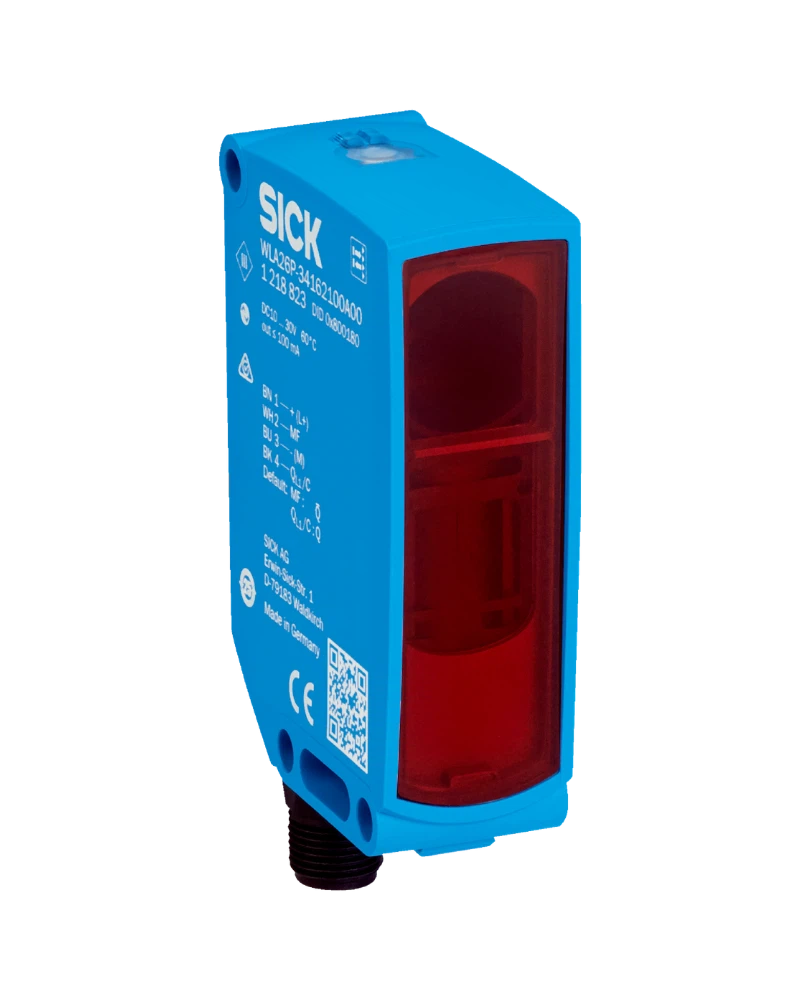
Explore performance details, construction highlights, applications, and technical information in one clear overview.
The SICK W26 photoelectric sensor is a versatile, ready-to-install device designed for demanding industrial environments. It combines retro-reflective and through-beam sensing in a single unit, offering flexibility across a wide range of applications. Featuring the robust VISTAL housing, the sensor is built to withstand extreme mechanical loads while maintaining reliable performance. Available with metal housings that meet ATEX requirements for device categories 3D and 3G, it is suitable for use in explosion-hazardous areas such as Zone 2 and Zone 22 (non-conductive dusts). With intuitive on-device configuration options and a visual sensing range display, the W26 delivers fast setup and clear operational insight—making it ideal for both new installations and maintenance tasks.
The W26 leverages TwinEye technology with two receivers in one sensor to ensure high detection reliability, especially on uneven, shiny, reflective, or jet black surfaces. This dual-receiver design enhances operational safety by reducing false detections. Foreground suppression mode reliably detects very flat, poorly reflecting, and reflective objects that are difficult to sense using standard sensors. The blue LED alignment aid simplifies the precise setup of sensor and reflector positions, accelerating installation accuracy. Additionally, the 2 in 1 teach-in function—combining a teach-in button with a potentiometer—enables intuitive fine-tuning in seconds, allowing users to adjust sensing parameters efficiently without external tools.
The W26 is available in multiple variants including WTM4FF, WTM4SF, WTM12F, WTM12L, WTM16F, and WTM26F, all offering MultiMode functionality. These modes include background suppression, foreground suppression, two-value teach-in, two independent switching points, and window mode—configurable directly on the device or via IO-Link. The sensor supports both retro-reflective and through-beam configurations. A visual representation of the sensing range is displayed at all times, enabling users to maintain full situational awareness during operation. The blue LED alignment aid assists in optimal positioning of sensors and reflectors or senders and receivers, ensuring consistent performance across diverse applications.
The W26 offers flexible configuration through its MultiMode feature, allowing users to set various operating modes directly on the device or via IO-Link. This enables seamless integration into existing control systems without requiring additional hardware. The combination of a teach-in button and potentiometer in one element allows for rapid parameter adjustment during setup—ideal for field technicians. With no need for complex programming, the sensor supports intuitive fine-tuning in seconds. Its ready-to-install design with metal housings simplifies integration into industrial automation systems while reducing inventory complexity through fewer variant types.
The W26 is designed to operate reliably in explosion-hazardous environments, complying with ATEX device categories 3D and 3G. It can be safely used in Zone 2 (flammable gas or vapor) and Zone 22 (non-conductive dusts). The VISTAL housing provides exceptional mechanical durability, enabling the sensor to withstand extreme loads during operation. The device is suitable for use in harsh industrial settings where vibration, impact, or physical stress may occur. Its robust construction ensures long-term performance under demanding conditions without compromising detection accuracy.
The W26 photoelectric sensor is ideal for applications requiring reliable object detection across diverse materials and surface types. It performs well on uneven, reflective, shiny, or jet black surfaces due to TwinEye technology and foreground suppression capabilities. Common use cases include packaging lines, material handling systems, conveyor monitoring, and automated assembly processes where precise object presence detection is critical. Its ability to detect flat, poorly reflecting objects ensures consistent performance in challenging environments. The sensor’s ease of alignment and intuitive setup makes it suitable for both new installations and routine maintenance tasks across a broad range of industrial sectors.
| Specification | Value |
|---|---|
| light source | . The W26 sensors deliver reliable detection thereby reducing unplanned machine downtimes. Ready-to-install variants with metal housings are available for explosion-hazardous areas that meet the requirements of device categories 3D and 3G according to ATEX. |
| sensing range | allows you to maintain an overview at all times |
Browse product families and jump into the exact catalog section you need.