
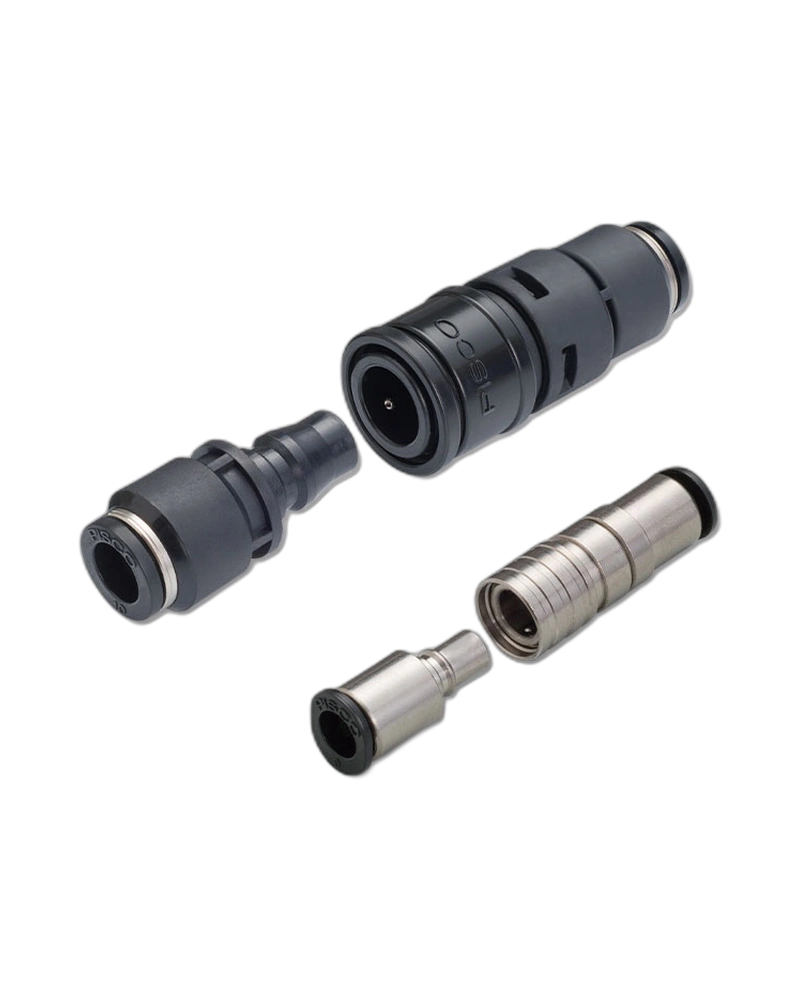
Explore performance details, construction highlights, applications, and technical information in one clear overview.
The Light Coupling is a quick-connect device designed for easy and secure connection and disconnection of pneumatic or fluid lines. It enables rapid assembly and disassembly with one-hand operation—simply push the plug in to connect or pull it out to disconnect—making it ideal for applications requiring frequent maintenance, tool changes, or temporary setups.
The coupling features a PBT resin body for its primary structural components, selected for durability and performance in general environmental conditions. The metal parts, including the housing and interface elements, are constructed from brass with electroless nickel plating to ensure corrosion resistance and long-term reliability under typical operating conditions.
The Light Coupling offers multiple plug types: standard, silencer, and check valve. The silencer type reduces noise and shock during release of residual pressure, while the check valve type prevents backflow of residual pressure after disconnection. All variants are designed to fit a range of connection interfaces including metric male threads (M5x0.8), taper pipe threads (R1/8, R1/4, R3/8, R1/2), UNF thread (10-32UNF), and NPT threads (NPT1/8, NPT1/4, NPT3/8, NPT1/2).
The coupling is rated for a maximum operating pressure of 0.9MPa and can handle a maximum vacuum of -100kPa. It operates within a temperature range of 0 to 60°C (no freezing), making it suitable for ambient conditions where thermal stability is essential. The seal material used is NBR rubber, which provides effective sealing but has limited ozone resistance.
Available in multiple sizes ranging from φ4 mm to φ12 mm, the Light Coupling corresponds to standard inch sizes: φ1/8", φ5/32", φ1/4", φ5/16", φ3/8", and φ1/2". This range ensures compatibility with a wide variety of industrial systems and equipment across different scales.
The coupling includes a socket equipped with a stop mechanism that automatically shuts off the flow when the plug is removed, ensuring safety during disconnection. This feature supports integration into systems where air or fluid flow must be safely terminated without manual intervention.
| Specification | Details |
|---|---|
| Fluid medium | Air, Water
Recommended products
Related Products
CategoryBrowse product families and jump into the exact catalog section you need. |