
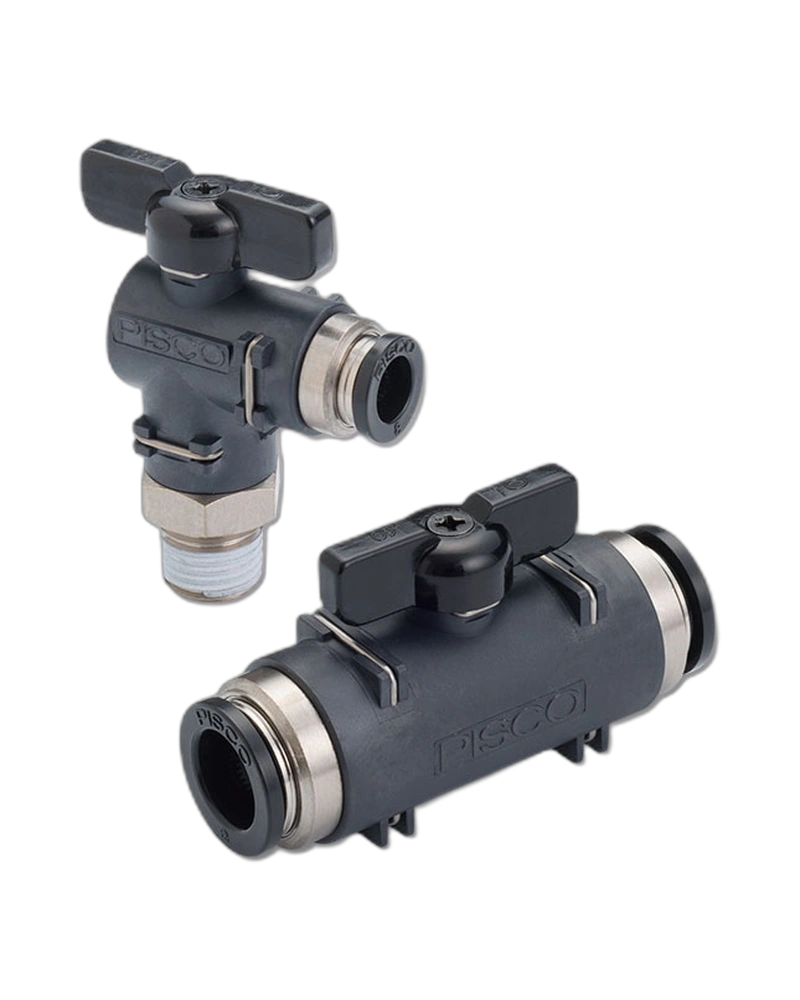
Explore performance details, construction highlights, applications, and technical information in one clear overview.
The Ball Valve (20 & 60 Series) is a precision pneumatic control valve designed to reliably turn on and off air pressure flow to pneumatic devices. It also supports water applications under specific conditions, making it suitable for a range of industrial automation systems where precise fluid flow control is required.
The valve features a main resin body constructed from PPS (Polyphenylene sulfide), which provides excellent heat resistance, flame retardancy (UL94 V-0 rating), and superior chemical resistance. The primary metal components are made of brass with electroless nickel plating, enhancing durability and corrosion protection in demanding environments. The sealing surface uses NBR (Nitrile Butadiene Rubber) material, a standard sealing solution known for its effectiveness in general fluid applications, though it has limited ozone resistance.
The valve is configured with threaded connections designed to interface directly with pneumatic or water systems. Dimensions provided are reference values measured after tightening the thread, ensuring accurate fitment when installed in standard piping or equipment configurations.
This ball valve operates within a maximum pressure range of 0.9MPa and can handle a maximum vacuum of -100kPa. It is rated for continuous operation between 0°C and 60°C, with no freezing allowed during use due to the material limitations under low-temperature conditions.
Available in two series—20 Series and 60 Series—the valves differ primarily in size and capacity, offering scalable options for various system requirements. All variants are offered in standard finishes; color is not specified in technical data.
Installation requires threading the valve into a compatible pipe or system using standard thread engagement. The design supports direct integration with pneumatic actuators or water delivery lines where air or water flow control is needed, and no additional fittings or adapters are required beyond standard threaded connections.
| Specification | Details |
|---|---|
| Fluid medium | Air, Water (Conditional*) |
| Max. operating pressure | 0.9MPa |
| Max. vacuum | -100kPa |
| Operating temp. range | 0
Recommended products
Related Products
CategoryBrowse product families and jump into the exact catalog section you need. |