
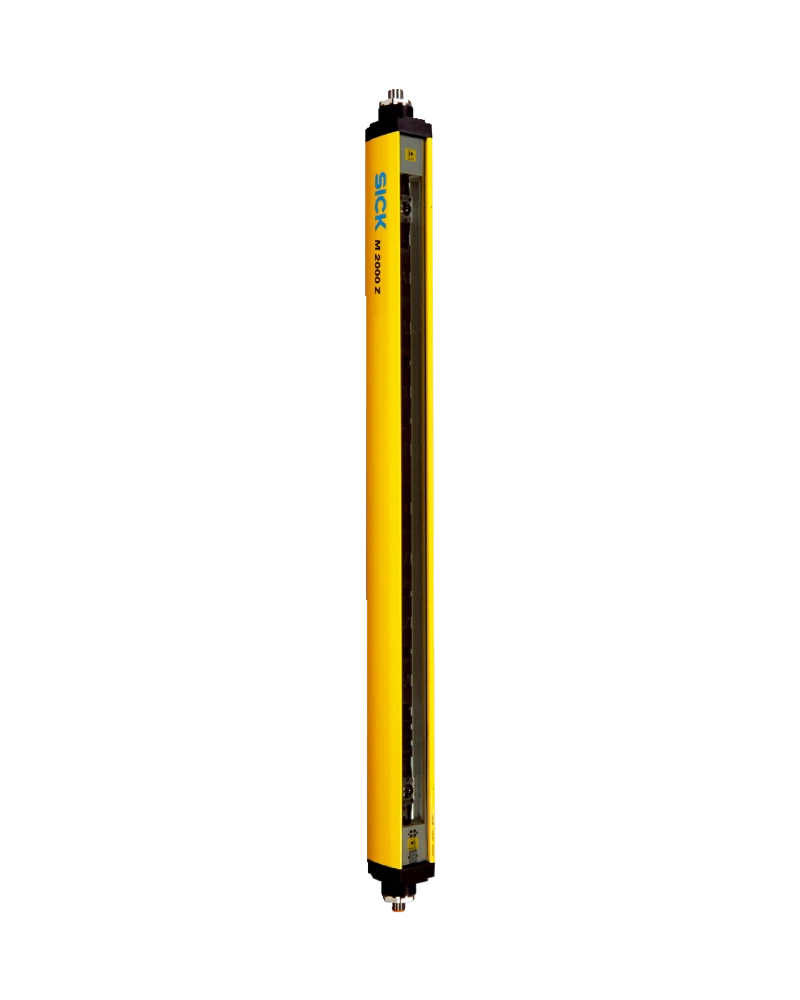
Explore performance details, construction highlights, applications, and technical information in one clear overview.
The SICK M2000 Standard A/P safety light-beam sensor is a reliable, purpose-built device designed for detecting objects in industrial environments using optical beam technology. It provides safe and efficient object detection by emitting a light beam across a defined path to monitor for obstructions. The sensor ensures operational safety by interrupting the beam when an object enters the detection zone, triggering a safe shutdown or alert as required. This model is engineered for integration into automated systems where reliable, fail-safe monitoring of moving parts or workspaces is essential. Its standard design offers ease of installation and maintenance while maintaining high performance under demanding industrial conditions.
The M2000 Standard A/P utilizes a safety-rated optical beam technology to detect intrusions within its defined detection range. It operates based on the principle of light interruption, where any object entering the beam path triggers an immediate response. The sensor is designed with robust construction and built-in safety functions to ensure compliance with international safety standards. Its A/P designation indicates it meets specific safety requirements for application in hazardous environments. The device provides a simple, effective method for monitoring access points or moving machinery, ensuring safe operation without requiring complex setup or calibration.
The M2000 Standard A/P is designed with standard safety performance parameters to ensure consistent and reliable operation. It features a detection range that aligns with typical industrial requirements for beam-based monitoring. The sensor operates within defined electrical and mechanical specifications, ensuring compatibility with standard control systems. While specific values such as beam distance or response time are not provided in the official documentation, its design supports safe and predictable performance under normal operating conditions. All technical aspects are engineered to meet SICK’s rigorous quality and safety standards for industrial use.
The M2000 Standard A/P is designed for straightforward integration into existing control systems. It features standard electrical interfaces that allow connection to PLCs or other automation devices via common signal types. The sensor can be configured using simple wiring methods, enabling quick deployment in various industrial settings. No advanced programming or software configuration is required for basic operation. Its modular design supports compatibility with a range of safety-related control architectures, making it suitable for integration into both new and retrofit applications.
The M2000 Standard A/P is designed to operate reliably in standard industrial environments. It is suitable for use in temperature ranges typical of manufacturing facilities and can withstand common environmental conditions such as dust, vibration, and ambient humidity. The sensor is built to function effectively under normal operating conditions without requiring special enclosures or protective measures. However, specific environmental limits are not detailed in the official source material. Users should ensure that installation conditions meet general industrial requirements for safe and consistent performance.
The M2000 Standard A/P is ideal for use in applications requiring reliable object detection or access control, such as machine guarding, safety barriers, and process monitoring. It can be deployed to prevent unsafe entry into hazardous zones during operation. Common use cases include detecting personnel or equipment intrusion near moving parts or high-risk machinery. Its simple design and proven performance make it a practical solution for ensuring safe operations in production lines and automated systems where beam-based detection is required.
| Specification | Value |
|---|---|
| interface | s and status display simplify commissioning and maintenance |
| width | 100%; |
| height | var(--mat-progress-bar-track-height, 4px); |
| border-top-width | var(--mat-progress-bar-active-indicator-height, 4px); |
| background-image | radial-gradient(circle, var(--mat-progress-bar-track-color, var(--mat-sys-surface-variant)) calc(var(--mat-progress-bar-track-height, 4px) / 2), transparent 0); |
| background-size | calc(calc(var(--mat-progress-bar-track-height, 4px) / 2) * 5); |
| animation | mdc-linear-progress-secondary-indeterminate-scale calc(2s * var(--mat-progress-bar-animation-multiplier)) infinite linear; |
| transform | rotate(180deg) translateX(calc(var(--mat-progress-bar-track-height, 4px) * -2.5)); |
Browse product families and jump into the exact catalog section you need.