
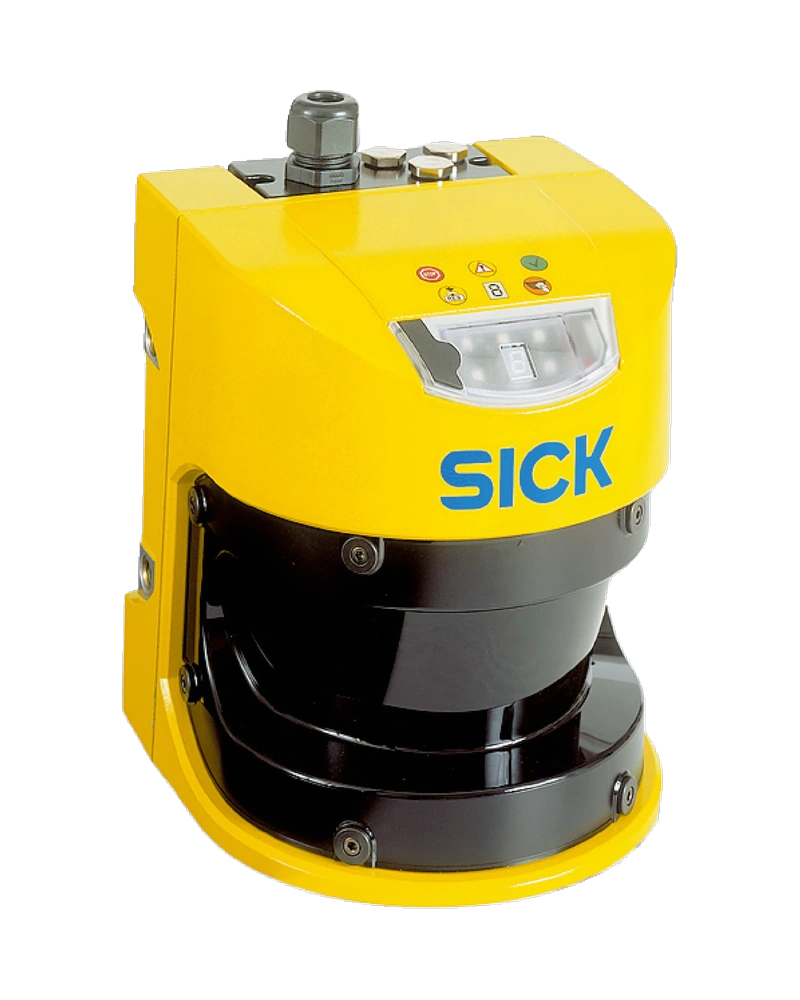
Explore performance details, construction highlights, applications, and technical information in one clear overview.
The S3000 Professional safety laser scanner is part of SICK’s advanced family of safety laser scanners, designed for high-performance industrial safety applications. Complementing the S300 model, the S3000 offers a proven combination of short response times and extended sensing ranges, enabling reliable detection in dynamic environments. This product is ideal for users seeking robust safety solutions that combine fast reaction capabilities with long-range monitoring. The training program covers both the function and application of these devices, providing comprehensive insight into their operational principles and real-world integration. Designed for professionals involved in machine safety design, the S3000 Professional ensures consistent performance through reliable detection technology, making it a trusted choice across diverse industrial settings.
The S3000 and S300 safety laser scanners are engineered for high-speed response and extended sensing capabilities. These devices operate on a principle of active optical detection using laser technology, enabling precise object identification within a defined range. Their short response times ensure immediate reaction to potential hazards, critical in fast-moving or high-risk environments. Both models support application-specific programming and offer clear fault diagnosis through integrated diagnostics. The technology is built for reliability under demanding conditions, with consistent performance across varying operational scenarios. These scanners are designed to detect objects without physical contact, reducing wear and maintenance needs while maintaining safety integrity.
The S3000 Professional safety laser scanner delivers high-performance detection with a focus on response speed and sensing range. While specific numerical values for sensing range or response time are not provided in the official source, the product is characterized by its short response times and long sensing ranges—key attributes that support effective hazard detection. These features ensure reliable performance across diverse industrial environments. The devices are designed to operate within defined safety limits and meet relevant safety standards. Their modular design allows for flexible configuration based on application needs, supporting both standard and customized operational scenarios.
The S3000 and S300 scanners can be integrated into machine controllers using established industrial protocols. Users are trained in the setup and principle of operation, including how to configure these devices through SICK Configuration & Diagnostic Software. This software enables programming of both models for specific safety functions, allowing application-specific logic development. Integration involves defining detection zones, setting up safety functions, and ensuring compatibility with existing machine control systems. The training covers fault diagnosis and troubleshooting techniques, enabling users to maintain system reliability over time.
The S3000 Professional is designed for reliable operation in industrial environments where temperature, humidity, and dust levels may vary. While exact environmental ratings are not specified in the source material, the product is built to function effectively under typical industrial conditions. It is intended for use in settings with potential mechanical or thermal stress, ensuring consistent performance during routine operations. The device supports continuous monitoring without degradation of detection accuracy, making it suitable for long-term deployment in demanding applications.
The S3000 and S300 safety laser scanners are ideal for use in a variety of industrial safety scenarios where reliable object detection is essential. These include automated production lines, robotic systems, and equipment with moving parts that pose potential hazards. The short response times and long sensing ranges make them suitable for detecting personnel or objects within large operational zones. Applications span across manufacturing, packaging, and material handling sectors. Their ability to integrate seamlessly into machine control systems ensures they can be deployed in complex safety networks where real-time detection is required.
| Specification | Value |
|---|---|
| Class size | Maximum 8 trainees |
| Maximum | 8 trainees |
Browse product families and jump into the exact catalog section you need.