
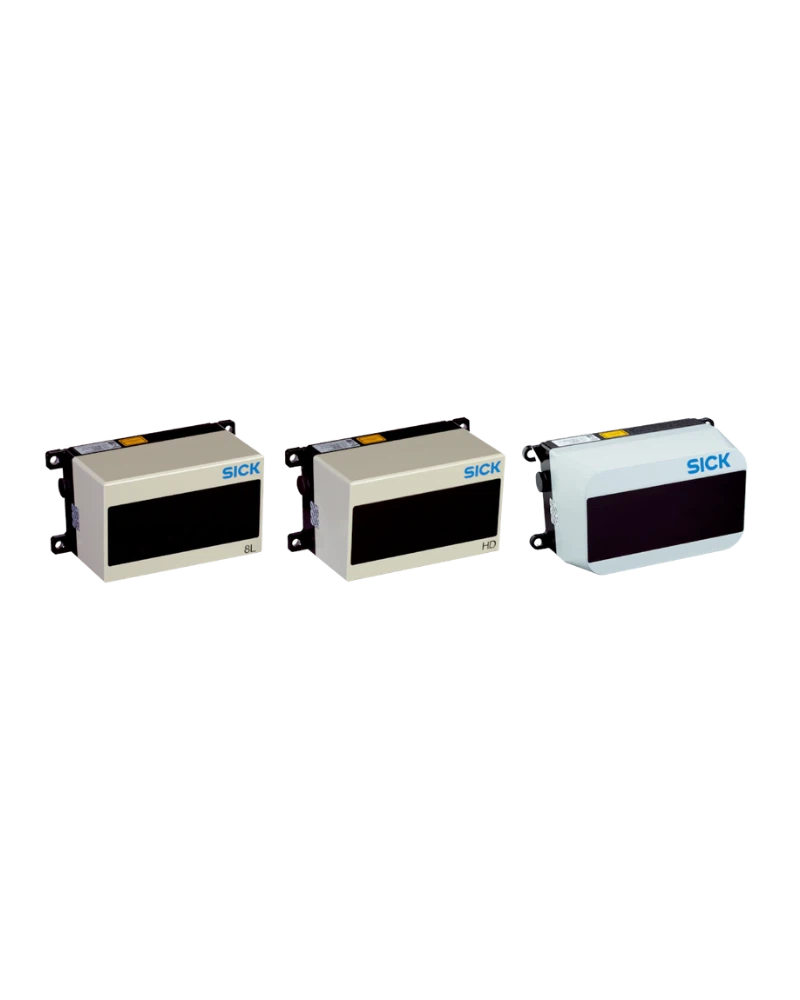
Explore performance details, construction highlights, applications, and technical information in one clear overview.
The SICK LD-MRS LiDAR sensor is a high-precision, long-range laser-based distance measurement device designed for industrial automation applications requiring accurate 3D spatial data. Utilizing infrared light at 905 nm (±10 nm), the sensor delivers reliable range detection over distances from 0.5 meters to 320 meters. With a scanning frequency ranging from 12.5 Hz to 50 Hz, it provides dynamic performance suitable for real-time monitoring and motion tracking. The sensor features an IP69K-rated enclosure and protection class III, ensuring robustness in harsh environments. Its compact design (94 mm × 165 mm × 88 mm) and lightweight construction (1 kg) make it ideal for integration into automated systems where space and durability are critical.
The LD-MRS employs infrared light at 905 nm (±10 nm) to generate precise distance measurements through time-of-flight technology. It offers angular resolution of 0.125°, 0.25°, or 0.5° horizontally and 0.8° vertically, enabling detailed spatial mapping depending on application needs. The sensor operates within a scanning range of 50 meters at a 10% remission factor, ensuring consistent performance under varying surface reflectivity conditions. With support for Ethernet (TCP/IP), RS-232 serial communication, and CAN bus interfaces, it enables flexible data transmission and integration into existing control systems. All values are typical; actual performance may vary based on environmental factors such as temperature, humidity, or ambient light.
The LD-MRS LiDAR sensor has a working range of 0.5 m to 320 m and achieves a scanning range of 50 m at a 10% remission factor. Scanning frequency ranges from 12.5 Hz to 50 Hz, allowing adaptation to different motion or object detection requirements. The sensor features an aluminum housing available in gray (RAL 7032) or black (RAL 9005). It is supplied with two Odu Mini-snap round connectors: a 4-pin connector for supply voltage and Ethernet, and a 12-pin connector for synchronization signals. Data transmission via Ethernet supports raw data interface and parameterization at up to 100 Mbit/s. Serial communication via RS-232 operates at 57,600 baud, while CAN bus support enables auxiliary interface connectivity.
The LD-MRS supports multiple integration options including Ethernet (TCP/IP), RS-232 serial, and CAN bus for flexible system compatibility. The Ethernet connection provides a raw data interface enabling real-time access to point cloud data at 100 Mbit/s, ideal for high-speed processing in automation environments. The RS-232 interface offers auxiliary communication at 57,600 baud, suitable for simple diagnostics or parameter adjustments. The CAN bus interface allows integration into vehicle or machine control systems requiring reliable signal synchronization. All connections use Odu Mini-snap round connectors, ensuring secure and easy plug-and-play installation. Integration is straightforward due to standardized interfaces and clear parameterization capabilities via the raw data interface.
The LD-MRS is designed for operation in demanding industrial environments with an IP69K enclosure rating providing full protection against dust and high-pressure water jets. It operates under protection class III, ensuring safety in high-voltage or hazardous settings. The sensor functions reliably across a wide range of environmental conditions, though actual performance may vary due to ambient factors such as temperature, humidity, or surface reflectivity. The working range and scanning accuracy are influenced by the object’s remission factor—specifically at 10% remission, the effective scanning range is 50 m. These characteristics ensure consistent operation in outdoor or high-contamination environments where reliability is essential.
The LD-MRS LiDAR sensor is suitable for a variety of industrial automation tasks including object detection, positioning, and motion monitoring. Its long range and angular resolution make it ideal for applications such as robotic navigation, automated guided vehicles (AGVs), and material handling systems. The sensor’s ability to operate in harsh environments with IP69K protection ensures durability in outdoor or wet installations. Applications include warehouse automation, assembly line inspection, and perimeter security where precise distance sensing is required. Its compatibility with Ethernet, CAN, and serial interfaces allows seamless integration into existing PLC or SCADA-based control systems.
| Specification | Value |
|---|---|
| Light source | Infrared light (905 nm, ± 10 nm) |
| Working range | 0.5 m ... 320 m |
| Connection type | 2, 1 x Odu Mini-snap round connector, 4-pin (supply voltage, ETH), Odu Mini-snap round connector, 12-pin (Sync) |
| Supply voltage | 9 V ... 30 V |
| Housing material | Al |
| Protection class | III |
| Weight | 1 kg |
| resolution | Horizontal 0.125° 0.25° 0.5° Vertical 0.8° |
| supply voltage | , ETH), Odu Mini-snap round connector, 12-pin (Sync) |
| Dimensions | (L x W x H) |
| interface | Data transmission rate 57,600 Baud |
| value | 100 Mbit/s |
| Scanning frequency | 12.5 Hz ... 50 Hz |
| Angular resolution Horizontal 0.125° 0.25° 0.5° Vertical 0.8° | Angular resolution | Horizontal | 0.125° | 0.25° | 0.5° | Vertical | 0.8° |
| Scanning range At 10% remission factor 50 m | Scanning range | At 10% remission factor | 50 m |
| key | Ethernet ✔ , TCP/IP Function Raw data interface/parameterization Data transmission rate 100 Mbit/s |
| At 10% remission factor | 50 m |
| Housing color | Gray (RAL 7032), black (RAL 9005) |
| Dimensions (L x W x H) | 94 mm x 165 mm x 88 mm |
| Data transmission rate | 100 Mbit/s |
| Serial ✔ , RS-232 Function Auxiliary interface Data transmission rate 57,600 Baud | Serial | ✔ , RS-232 | Function | Auxiliary interface | Data transmission rate | 57,600 Baud |
| Ambient operating temperature | –40 °C ... +70 °C |
| Ambient light immunity | 100 klx |
| Unit weight | 1.351 Kilograms |
| Net unit weight | 1.351 Kilograms |
| Scanning range At | 10% remission factor 50 m |
Browse product families and jump into the exact catalog section you need.