
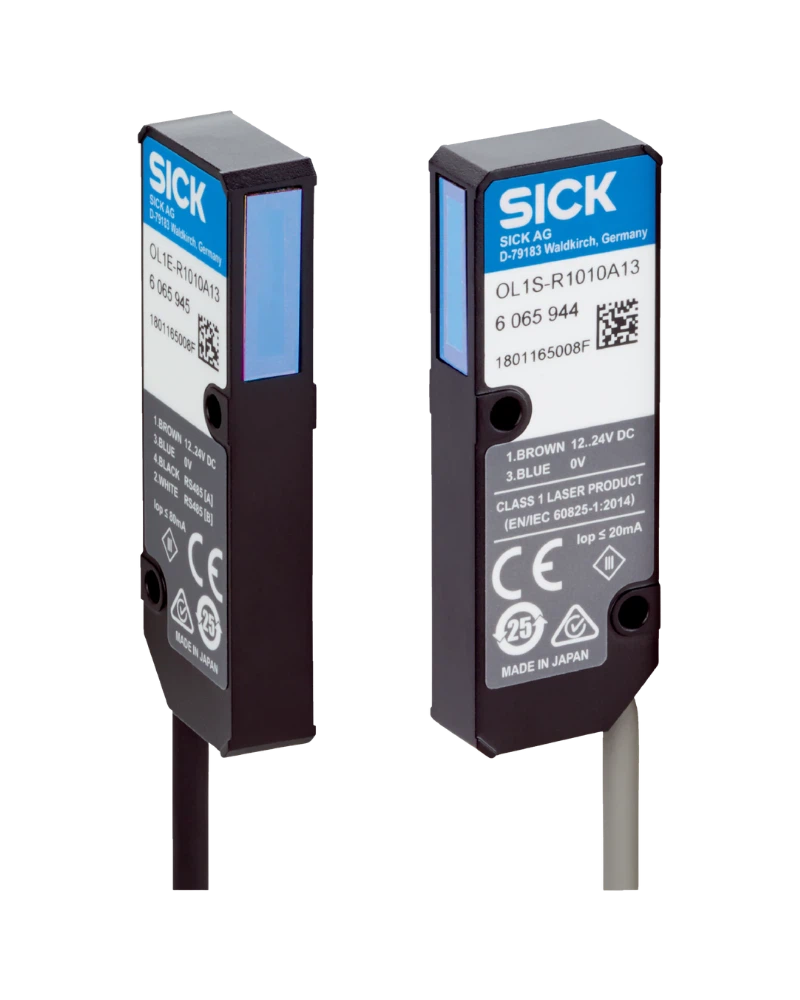
Explore performance details, construction highlights, applications, and technical information in one clear overview.
The SICK OL1 laser distance sensor is a high-precision measurement solution designed for accurate edge detection and positioning in demanding industrial environments. It leverages advanced triangulation technology to detect material edges with micrometer-level accuracy, making it ideal for applications requiring repeatable and reliable measurements. The sensor excels in guiding semi-transparent materials or thin, delicate components such as textile threads and wires by precisely identifying their position. Its robust performance ensures consistent results even under challenging conditions, supporting both automated guidance systems and quality control processes. With a focus on precision and reliability, the OL1 delivers dependable edge detection across diverse production scenarios where fine positioning is critical.
The OL1 uses triangulation technology to determine object position: a point of light is projected onto the measuring surface, and the reflected light is captured by a light-sensitive receiver at a specific angle. Based on the geometric relationship between the emitted and received light directions, the sensor calculates the distance using the principle of triangulation from Latin ‘triangulum’ meaning triangle. This method enables precise detection in the micrometer range, ensuring high accuracy for edge positioning tasks. The sensor’s high performance reserve allows it to reliably detect edges on semi-transparent materials or consistently reposition thin wires and textile threads back onto their correct path, demonstrating exceptional adaptability across different material types.
The OL1 laser distance sensor delivers precise edge detection with a measurement accuracy in the micrometer range. It is specifically engineered to detect edges on semi-transparent materials and reliably guide thin textile threads or wires back onto their correct path. The sensor’s high performance reserve ensures consistent results, even when dealing with challenging material properties such as low reflectivity or transparency. This makes it suitable for applications requiring repeatable positioning in tight tolerances. While specific ranges are not provided in the source data, its design emphasizes precision and reliability under real-world production conditions.
The OL1 sensor is designed to integrate seamlessly into existing industrial automation systems. Its output signals can be used directly for feedback control or machine logic, enabling real-time edge detection in automated processes. SICK provides comprehensive support during the design, commissioning, and operational phases of machinery integration. This includes on-site assistance to ensure correct setup and optimal performance. Modular service contracts are available to extend equipment lifespan and improve system availability through regular maintenance and performance checks. When limit values are exceeded or faults occur, the sensor continuously monitors and alerts systems accordingly.
The OL1 is designed for reliable operation in industrial environments where precision measurement is essential. It performs consistently across a range of conditions, including varying material types such as semi-transparent substrates and thin wires. The sensor maintains its accuracy even when exposed to challenging physical properties that affect reflectivity or edge definition. While specific environmental ratings are not detailed in the source, its performance under real-world production demands indicates robustness against typical industrial conditions. Continuous monitoring ensures early detection of deviations, supporting safe and efficient operation.
The OL1 laser distance sensor is particularly effective in battery production for the repeatable guidance of electrode materials and in thin wafer manufacturing where double-layer edge detection is required. It is also used to guide delicate components such as thin textile threads or wires, ensuring consistent alignment during assembly processes. These applications benefit from its ability to detect edges with micrometer-level precision on semi-transparent or low-reflectivity surfaces. The sensor’s reliability and high performance reserve make it a trusted solution in environments where product quality and process consistency are paramount.
| Specification | Value |
|---|---|
| material | in battery production or the double layer detection of thin wafers. Due to the high performance reserve, the OL1 determines the edge position of semi-transparent materials exactly or reliably moves thin textile threads or wires back on the right track. |
Browse product families and jump into the exact catalog section you need.