
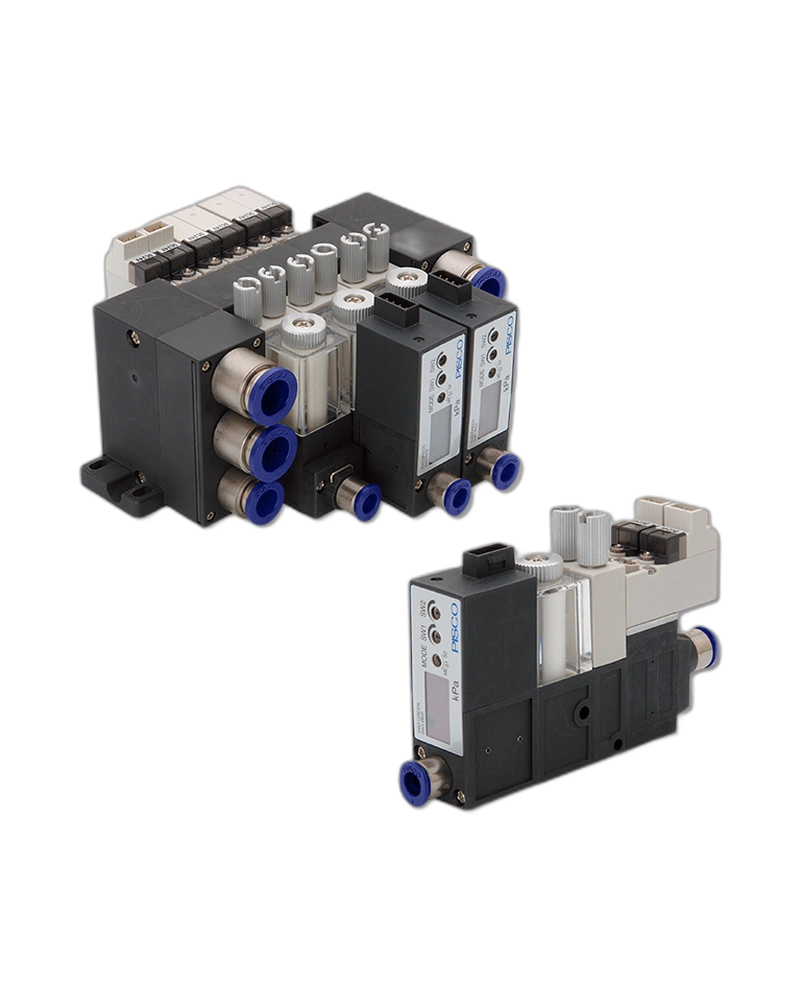
Explore performance details, construction highlights, applications, and technical information in one clear overview.
The External Vacuum Controller VJP (-S3 spec.) is a multitasking vacuum control device designed to manage both flow and pressure in industrial vacuum systems. It combines conventional blow-off air flow adjustment with an added pressure control function, enabling precise regulation of workpiece retention during vacuum operations. This dual functionality prevents workpieces from being blown away during operation, improving safety and process reliability in automated handling environments.
The controller is constructed using non-copper metallic materials throughout its flow paths to avoid potential contamination or corrosion issues. The seal rubber components utilize low-concentration ozone-resistant HNBR or FKM elastomers, ensuring durability under varying environmental conditions. All internal elements are made from PVFM (polyvinyl formal), a material selected for its chemical resistance and long-term stability in air-based applications.
The VJP (-S3 spec.) features three different supply valve types to accommodate various system configurations. It connects via standard piping interfaces designed for integration with manifold systems, allowing it to function as either a normally closed or normally open valve, or as a double-piloted configuration. The device includes an integrated relief function that safely releases excess pressure from the blow-off circuit during operation.
The controller operates within a pressure range of 0.3 to 0.7 MPa (equivalent to -100 to 0 kPa), with a temperature range of 5 to 50°C and humidity range of 35 to 85% RH—conditions under which no freezing or dew condensation occurs. It is rated for proof pressure of 1.05 MPa in the air supply circuit and 0.2 MPa in the vacuum circuit. The device operates on a 24 VDC ±10% or 100 VAC ±10% power supply, with an optional 12 to 24 VDC ±10% range (ripple P-P: 10% max).
The blow-off air flow rate ranges from 0 to 50 L/min [ANR] at a supply pressure of 0.5 MPa, with the blow-off pressure setting adjustable between -25 and +25 kPa. Pressure settings are available in two configurations: one with two preset levels and another with a single setting. The device uses a diffused semiconductor pressure switch for detection, with a pressure setting range from -99 to 0 kPa.
The VJP (-S3 spec.) is designed for indirect operation via a pilot valve system. It integrates seamlessly into existing vacuum manifold systems and supports integration points that include both air supply and vacuum circuit connections. The device features a fast response time: from OFF to ON in as little as 8 to 15 milliseconds (depending on power source), and from ON to OFF in 15 to 23 milliseconds, enabling rapid cycle control for dynamic process requirements.
| Specification | Details |
|---|---|
| Fluid medium | Air [JIS B 8392-1: (Class 1.2.1 to 2.4.3)] |
| Operating pressure range | 0.3 to 0.7 MPa | -100 to 0 kPa |
| Operating temperature range | 5 to 50°C (No freezing) |
| Operating humidity range | 35 to 85% RH (No dew condensation) |
| Proof pressure (air supply circuit) | 1.05 MPa |
| Proof pressure (vacuum circuit) | 0.2 MPa |
| Rated voltage | 24 VDC ±10% | 100 VAC ±10% | 12 to 24 VDC ±10%, ripple (P-P): 10% max. |
| Operating type | Indirect operation by pilot valve |
| Valve type | Normally closed | Normally open | Double-piloted *1 |
| Response time (OFF→ON) | 10 msec [15 msec] (24 VDC) / 13 msec [18 msec] (100 VAC) | 15 msec [20 msec] (24 VDC) / 18 msec [23 msec] (100 VAC) | 8 msec [13 msec] (24 VDC) / 11 msec [16 msec] (100 VAC) |
| Response time (ON→OFF) | 30 msec [35 msec] (24 VDC) / 33 msec [38 msec] (100 VAC) | 20 msec [25 msec] (24 VDC) / 23 msec [28 msec] (100 VAC) | 15 msec [20 msec] (24 VDC) / 18 msec [23 msec] (100 VAC) | 18 msec [23 msec] (24 VDC) / 21 msec [26 msec] (100 VAC) |
| Element material | PVFM (polyvinyl formal) |
| Blow-off air flow rate | 0 to 50 L/min [ANR] (Supply pressure: 0.5 MPa) |
| Blow-off pressure setting range | -25 to 25 kPa |
| Current consumption | 40 mA max. |
| Pressure detection | Diffused semiconductor pressure switch |
| Pressure setting range | -99 to 0 kPa |
| Proof pressure | 0.2 MPa |
| Power supply voltage | 12 to 24 VDC ±10%, Ripple (P-P): 10% max. |
| No. of pressure settings | 2 | 1 |
| Switch output | NPN open collector (30 V, 80 mA max., Residual voltage: 0.8 V max.) | NPN open collector (30 V 80 mA max., residual voltage: 0.8 V max.) |
| Response time | Approx. 2 msec |
| Analog output: Output voltage | 1 to 5 V |
| Analog output: Zero-point voltage | 1 ±0.1 V |
| Analog output: Span voltage | 4 ±0.1 V |
| Analog output: Output current | 1 mA max. (Load resistance: 5 kΩ min.) |
| Analog output: Linearity/Hysteresis | ±0.5% F.S. max. (Standard temp.: 25°C) |
| Metric size (mm) | φ4, φ6, φ8 | φ4, φ6 | φ6, φ8, φ10 | φ8 | φ8, φ10 |
| Material restriction | No copper-based metallic material is used in flow paths |
| Pressure sensor configuration | Two types of pressure sensor are available, two switch outputs, or 1 switch output + 1 analog output, to be selected depending on the desired application. For wiring, a connector wire is adopted to enhance the ease of designing the wiring layout |
Browse product families and jump into the exact catalog section you need.