
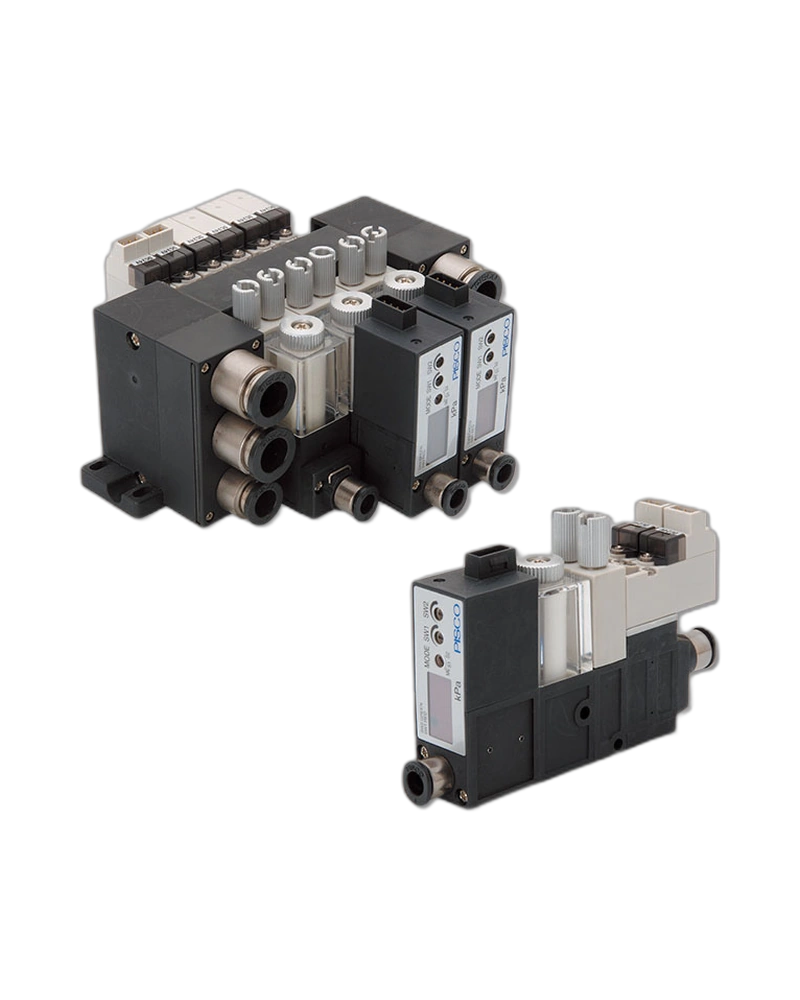
Explore performance details, construction highlights, applications, and technical information in one clear overview.
The External Vacuum Controller VJP is a multitasking vacuum control device designed to manage both flow and pressure in industrial air systems. It combines conventional blow-off flow adjustment with an added pressure control function, enabling precise management of workpiece retention during vacuum operations. This prevents workpieces from being blown away during operation, improving safety and product quality in automated processes involving delicate or moving components.
The controller is constructed without any copper-based metallic materials in its flow paths, ensuring compatibility with non-corrosive and ozone-sensitive environments. The seal rubber material uses low-concentration ozone-resistant HNBR or FKM elastomers, which are specifically selected for durability under vacuum and pressure conditions. All internal components are made from PVFM (polyvinyl formal), a material known for its chemical resistance and stability in demanding industrial settings.
The VJP features three different supply valve types to accommodate various system configurations. It connects via standard air lines and includes a built-in relief function that safely releases excess pressure from the blow-off circuit, preventing over-pressurization. The device operates through indirect pilot valve control, allowing it to respond to external signals without direct mechanical linkage.
The VJP is designed for operation within an air medium compliant with JIS B 8392-1 (Class 1.2.1 to 2.4.3). It operates over a pressure range of 0.3 to 0.7 MPa in the supply circuit and from -100 to 0 kPa in vacuum conditions. The operating temperature range is 5 to 50°C, with no freezing risk, and humidity levels between 35% and 85% RH are supported without dew condensation. Proof pressures of 1.05 MPa (air supply) and 0.2 MPa (vacuum circuit) confirm robustness under test conditions.
The controller is available with two pressure setting options: one allowing for a full range of -99 to 0 kPa, and another with a single setting at zero. It supports power supply voltages from 12 to 24 VDC ±10%, with ripple (P-P) limited to 10% max. The device is rated for 24 VDC ±10% or 100 VAC ±10%, and current consumption remains at a maximum of 40 mA.
The VJP integrates directly into existing vacuum systems through its standard air connections and pilot valve interface. It operates in either normally closed, normally open, or double-piloted configurations depending on the required control logic. The device features a diffused semiconductor pressure switch for accurate pressure detection and offers fast response times: 8 to 15 msec (OFF→ON) and 15 to 23 msec (ON→OFF), depending on supply voltage, enabling rapid system response during dynamic vacuum operations.
| Specification | Details |
|---|---|
| Fluid medium | Air [JIS B 8392-1: (Class 1.2.1 to 2.4.3)] |
| Operating pressure range | 0.3 to 0.7 MPa | -100 to 0 kPa |
| Operating temperature range | 5 to 50°C (No freezing) |
| Operating humidity range | 35 to 85% RH (No dew condensation) |
| Proof pressure (air supply circuit) | 1.05 MPa |
| Proof pressure (vacuum circuit) | 0.2 MPa |
| Rated voltage | 24 VDC ±10% | 100 VAC ±10% | 12 to 24 VDC ±10%, ripple (P-P): 10% max. |
| Operating type | Indirect operation by pilot valve |
| Valve type | Normally closed | Normally open | Double-piloted *1 |
| Response time (OFF→ON) | 10 msec [15 msec] (24 VDC) / 13 msec [18 msec] (100 VAC) | 15 msec [20 msec] (24 VDC) / 18 msec [23 msec] (100 VAC) | 8 msec [13 msec] (24 VDC) / 11 msec [16 msec] (100 VAC) |
| Response time (ON→OFF) | 30 msec [35 msec] (24 VDC) / 33 msec [38 msec] (100 VAC) | 20 msec [25 msec] (24 VDC) / 23 msec [28 msec] (100 VAC) | 15 msec [20 msec] (24 VDC) / 18 msec [23 msec] (100 VAC) | 18 msec [23 msec] (24 VDC) / 21 msec [26 msec] (100 VAC) |
| Element material | PVFM (polyvinyl formal) |
| Blow-off air flow rate | 0 to 50 L/min [ANR] (Supply pressure: 0.5 MPa) |
| Blow-off pressure setting range | -25 to 25 kPa |
| Current consumption | 40 mA max. |
| Pressure detection | Diffused semiconductor pressure switch |
| Pressure setting range | -99 to 0 kPa |
| Proof pressure | 0.2 MPa |
| Power supply voltage | 12 to 24 VDC ±10%, Ripple (P-P): 10% max. |
| No. of pressure settings | 2 | 1 |
| Switch output | NPN open collector (30 V, 80 mA max., Residual voltage: 0.8 V max.) | NPN open collector (30 V 80 mA max., residual voltage: 0.8 V max.) |
| Response time | Approx. 2 msec |
| Analog output: Output voltage | 1 to 5 V |
| Analog output: Zero-point voltage | 1 ±0.1 V |
| Analog output: Span voltage | 4 ±0.1 V |
| Analog output: Output current | 1 mA max. (Load resistance: 5 kΩ min.) |
| Analog output: Linearity/Hysteresis | ±0.5% F.S. max. (Standard temp.: 25°C) |
| Metric size (mm) | φ4, φ6, φ8 | φ4, φ6 | φ6, φ8, φ10 | φ8 | φ8, φ10 |
| Material restriction | No copper-based metallic material is used in flow paths |
| Pressure sensor configuration | Two types of pressure sensor are available, two switch outputs, or 1 switch output + 1 analog output, to be selected depending on the desired application. For wiring, a connector wire is adopted to enhance the ease of designing the wiring layout |
Browse product families and jump into the exact catalog section you need.